
I had been meaning to return the stack of books on my passenger seat for the better part of a week. Between a donut order for the volunteer fire department’s annual breakfast and a wedding cake that required more structural engineering than I am qualified for, the library had not made it onto my list. But Tuesday afternoon arrived with a gap, and I decided to take it as a sign.
The Flat Rock Public Library sits on the corner of Third Street and Monroe, just a block off Jefferson, in a building that used to be the old post office before the town outgrew it sometime in the sixties. Ms. Loring has run it for as long as most people can remember. She wore long skirts and cardigans in colors that suggested she picked them based on mood. The woman also knew every patron by name, every book by location, and more about this town's reading habits than anyone probably realized.
I pushed through the door with my stack and found the front counter empty except for a woman I didn't recognize, standing with a small collection of hardbacks tucked under one arm.
"She stepped away to help someone in the computer room," the woman said, nodding toward the back of the library. "She said she'd only be a minute."
"That's Ms. Loring," I said, setting my returns on the counter. "She'll be back. She always is."
The woman smiled. She was a few years younger than me, with sharp, observant eyes and the easy confidence of someone who felt at home wherever she went. The books under her arm were not light reading. I caught the spine of one. Something philosophical, with a title that would give me a headache before the second chapter.
"You come here often?" she asked.
"I’ve been a card-carrying member since I was four," I responded. "You?"
"First time, actually. I'm just passing through, and I needed some reading material."
I glanced at the stack she was holding. "That's a bit beyond what my mind has time for," I said. "I prefer a little mystery in between recipes."
She laughed at that. A genuine one. "Recipes?"
"I own the Bear Claw Bakery, over on Jefferson Street. Brenda Welch."
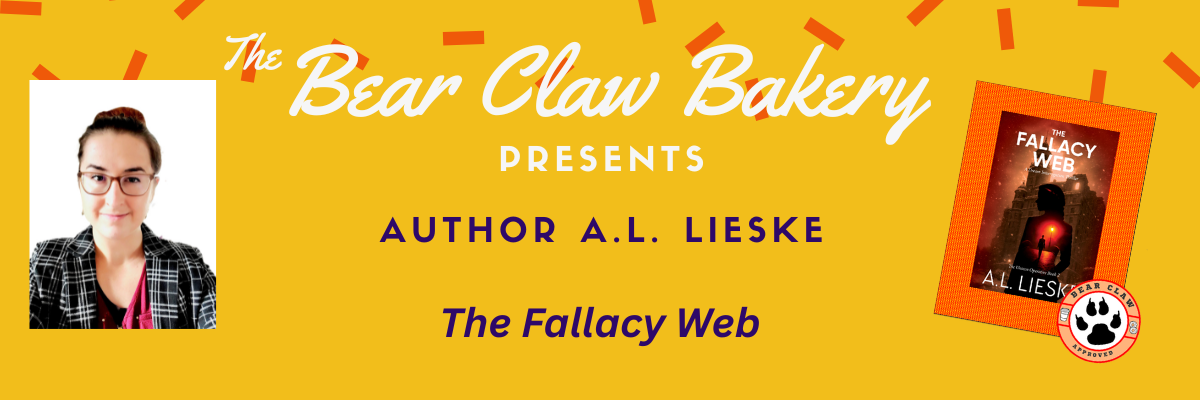
"A.L. Lieske."
Before either of us could continue, the soft footfall of leather boots on carpet announced Ms. Loring's return from the stacks. She came around the corner with an apology already forming on her face, saw me, and stopped.
"Brenda." Her face lit up, as if running into me were exactly what she'd hoped for when she turned that corner. She glanced between the two of us. "Have you two met?"
"Just now," I said.
Ms. Loring looked at A.L. and then back at me like she'd planned the whole thing.
"A.L. writes mysteries," she said.
I looked at my new acquaintance. "Really."
"Among other things," A.L. said.
"Do you have a few minutes?" I asked. It was obviously my lucky day. "I have a notebook and a lot of questions."
We settled at the reading table near the window, the one with the good light and the view of the maple tree that Ms. Loring insists on keeping even though its roots are doing something alarming to the sidewalk. I reached into my bag for my journal. I keep one with me always, because recipe ideas have no respect for scheduling, and set it on the table between us.
A.L. looked at it. "Do you always carry that?"
"I never know when something will strike," I said, flipping it open to a clean page. "Tony, my boyfriend, uses his phone for notes. I told him once that I didn't trust anything I couldn't hold in my hand."
"What's that?" A.L. asked, nodding at the page I'd opened to.
I looked down. A recipe I'd been working on for the past week, half-finished in my own handwriting. Lemon poppy seed muffins. Gluten and dairy-free. I'd been testing variations since a regular customer had asked if we had anything her granddaughter could eat.
I looked up at A.L.
"Dietary restrictions?" I asked.
She stared at me. "How did you —"
"It's a gift," I said, waving off the question. "Tell me about yourself. Not the author version, the real one."
She smiled at that, and I had the feeling she appreciated the distinction.
"I am many things," she said. "An ongoing speculator. A resource junkie. A diabolical prankster, if the opportunity presents itself." She paused. "I was a nonfiction writer long before I ever wrote fiction. Theology, philosophy, and health studies. I spent years forming conclusions from observations. About people, behavior, and the way things connect beneath the surface." She glanced toward the stacks. "Libraries like this one are something of a natural habitat."
"What brought you to mysteries specifically?" I asked. "Was there a moment?"
"There was never a singular moment," she said. "More like a pattern. I have always had a speculative mind. I indulge in crime noir, unsolved cases, and behavioral studies. But I never intended to write a mystery." She paused. "One day in January of last year, I sat down to write and out came a chapter of fiction. I stepped away thinking, ‘What on earth?’ The story kept coming, and so it was written." She smiled. "I finished the first draft of my second book the same month I published the first."
I set down my pen. "The same month?"
"My mind does not always cooperate with reasonable timelines."
"Mine either," I said. "I once came up with seventeen variations of a honey lavender scone between midnight and two in the morning and had to test all of them before I could sleep." I paused. "My mind and I have an understanding. It gives me ideas whenever it wants. I write them down and don't complain."
A.L. looked at me. "Without a doubt," she said.
"Who shaped how you write?" I asked.
She thought about it before answering.
"John A. Widtsoe," she said. "He was a scientist and theological writer. His ability to draw rapid and meaningful connections between ideas was always deeply inspiring to me. Mystery requires that. The ability to connect motive, behavior, and consequence. It cannot be superficial." She paused. "Carolyn Keene, for excitement and humor woven into investigations. And Sir Arthur Conan Doyle, because Holmes and Watson have occupied my imagination since childhood."
"Doyle," I said. "Yes. There is something about Holmes. The way he sees what everyone else walks past." I looked out the window for a moment. "I think about that sometimes. How much happens in a small town that nobody notices because they stopped looking."
A.L. looked at me like she'd just decided she was in the right conversation.
"Tell me about your main character," I said.
"Azure Prescott," she said. "She begins the series as a low-level agent simply trying to find her footing. Intelligent, observant, but not introduced as some extraordinary prodigy." She paused. "She grew up in Montana and spent time in foster care. She also struggles with insomnia, and it was that insomnia that led her into a volunteer sleep study, and that study gave her an ability she never asked for."
"What kind of ability?"
"She can enter the subconscious dreams of others."
I looked at her for a moment. Ms. Loring moved somewhere in the stacks behind us, reshelving something.
"While they're sleeping?" I asked.
"While they're sleeping," A.L. confirmed.
"To investigate?"
"To uncover hidden truths, yes."
I wrote that down slowly. "I have questions about that," I said. "But finish telling me about Azure first."
A.L. smiled. "The difficult thing about her is that she is intelligent without always being wise. She thinks deeply, analyzes constantly, and often comes very close to the right conclusion, but acts a moment too soon. Her curiosity leads her into trouble regularly." She paused. "But she is loyal and genuinely good. She joined the Bureau because she wanted to contribute something meaningful. Beneath everything, she is not selfish by nature."
"She sounds like someone who would be very hard on herself," I said.
A.L.'s expression changed. "She is."
"I know a few people like that," I said, and left it there. "Now," I said, "your world. Because I have to ask. What on earth does it look like?"
She laughed…fully, this time. "Buckle up," she said.
I did.
She described it in layers. The near future, the late 2430s, the aftermath of a third world war. Society rebuilt from catastrophe, reverting in many ways to the aesthetics and values of the early 1900s. Technology restricted, heavily monitored. Trains are the primary mode of transportation. Public telephone booths returned. Live operators.
"A whole rebuilt justice system," she continued. "Every federal and state agency consolidated into one layered structure called the Bureau."
"So, no small-town police departments," I said.
"Not in the traditional sense, no."
I thought about Chief Kent Larson for a moment. About Greg Ortworth. About the way history informs every interaction when everyone knows everyone. I wasn't sure the Bureau could replicate that. But I kept the thought to myself.
"And beneath all of that," A.L. continued, "there is a second world. The Dreamscape. The subconscious realm Azure enters during investigations. Each dream operates almost like its own contained mystery."
"So, there are two mysteries happening at once," I said. "The one in the waking world and the one in the dream."
"Usually, yes."
"That," I said, "is either brilliant or going to give me insomnia."
She pointed at me. "That is most definitely what Azure would say."
"Where do your plots come from?" I asked. "Do you know who did it before you start writing?"
"My subconscious," she said. "Honestly, that is the best answer I have. When I wrote the first book, I truly had no clear understanding of the full plot beforehand. The story continually surprised me." She paused. "With The Fallacy Web, the title itself operates on multiple layers. The central mystery is built around a web of human fallacies and behavioral patterns. But in the latter third of the book, there is a second web of fallacies. One that is unintentionally created by the perpetrator. I didn’t fully recognize that layer myself until I was approaching those chapters."
"So, you discovered it alongside the reader," I said.
"Exactly."
"I find that happens with recipes, too," I said. "I’ll start with an intention, and somewhere in the middle, the thing becomes something else entirely. And it's usually better than what I had planned."
A.L. looked at me. "You keep doing that."
"Doing what?"
"Finding the parallel," she said. "Between what I do and what you do."
"People are more similar than they think," I said.
She sat with that for a moment, and I continued.
"What should readers know before picking up your book?" I asked. "Something that might surprise them?"
"I think they may be most surprised by how different the series feels from a typical mystery thriller," she said. "It does not follow conventional structure, yet it still firmly belongs within the genre. There is humor, romance, psychological tension, and, of course, high-stakes investigations. Readers who enjoy the charm and banter of a good mystery tend to connect with it very quickly." She paused. "But perhaps the most meaningful surprise is the emotional and thematic depth beneath the surface. Themes of mercy, ethics, accountability, and humanity. Some readers have told me certain scenes felt intensely personal to them."
"It seems like the best ones always do," I said. "I know what my day usually entails…what does a writing day look like for you?”
She laughed. "It’s never the same. Some days, I’ll disappear completely into the story and write between five and seven thousand words. Other days, I’ll lose momentum entirely because marketing or the podcast pulls me away." She paused. "A large portion of my books are actually written through pinned emails to myself. If a scene or line of dialogue strikes me during the day, I email it to myself immediately before it disappears."
I looked at the journal on the table between us.
"Different tools," I said.
"Same process," she said.
We smiled at each other across the table.
"Is there a character you have a soft spot for?" I asked. "One that readers might not expect?"
"Jude," she said, and something crossed her face. "Something occurs involving Jude in The Fallacy Web that affected me enough emotionally that I wrote an entirely separate standalone novella to offer some measure of grace to his fiancée." She paused. "There is also Christofferson Tate. A Southern dreamwalker who is far too relaxed for the kind of work he does. I didn’t expect to become attached to him. But somewhere along the way, I found myself rooting for him far more than I intended."
"The ones you don't plan to love are always the ones," I said.
"Always," she agreed.
"And what are you reading right now?"
"I am trapped in a cycle of beta and ARC reads I’m not allowed to discuss yet. Outside of those, I’m reading a theological study on death, and a mystery called Joint Investigation by Terri Reed." She paused. "Beyond books, I spend a great deal of time reading studies on science, psychology, and family dynamics. Those ideas inevitably surface somewhere in the writing, even when I don't plan for them to."
"For me, it's people," I said. "I read people. Constantly. Occupational habit." I glanced at the journal. "And apparently, accidental recipe development."
A.L. smiled.
"O.K., final question. What makes a mystery satisfying to you?" I asked.
"A satisfying mystery respects the reader's requirement to participate," she said. "If a story doesn’t actively engage my mind in trying to discern the perpetrator, motive, or larger truth, it becomes entertainment easily discarded afterward." She paused. "I want atmosphere. Tension. Charismatic and conflicting personalities. A problem that appears to point in one direction until something shifts and forces me to question everything again." She looked at me. "I also find mysteries deeply unsatisfying when they conclude with a perfectly tidy happily ever after. That’s rarely the human experience. Crime and betrayal, grief and discovery, those things leave lasting effects. The most satisfying mysteries resolve the central questions while still leaving emotional weight behind after the final page."
"Good wins," I said. "But it costs something."
A.L. looked at me. "Yes," she said. "Perfectly put."
"Before I wrap up," I said. "I ask everyone this. If Azure walked through the door of my bakery right now and ordered something, what would it be?"
A.L. glanced at my journal full of notes, the lemon poppy seed muffin recipe sitting several pages back...
"A muffin," she said. "She has a fondness for them. It is one of the few preferences we share." She paused. "She would limit herself to one. Unless, of course, she was working a case and required a bribe."
I looked down at my notebook and then at A.L.
"Tell her," I said, "that we have exactly what she needs."
I closed the journal and tucked it back into my bag. Outside the maple tree, casting long afternoon shadows across the sidewalk. Somewhere in the stacks, the quiet sound of books being moved.
We both stood, and Ms. Loring looked up from the counter as we turned to leave. She was smiling as if she'd planned the whole thing. I'd come to the library to return a few books. Instead, I was leaving with a journal full of notes for my next Baker's Dozen interview and a new mystery series to add to my ever-growing reading list.
The Fallacy Web is Book Two in The Unseen Operative Series. Find A.L. at allieske.com and on Instagram at @a.l.lieske_author.
Finally found a site that doesn’t lag during peak hours. The login process is quick and the games are top notch. Great job on the optimization! jiligo88login
The customer service here is top notch. I had a small issue with my account and they fixed it in minutes. Great job by idpiala88 for keeping players happy.
If you are looking for a place with a great variety of slots and a friendly vibe this is it. I am having a blast on popi99slot
I’m impressed by how stable the connection is even on mobile data. Great experience overall with 93jililogin, keep it up.
Perfect for local players! The bonuses are generous and the site loads quickly even on mobile data. Glad I found jilibet019philippines.
The login process is secure and very straightforward. I appreciate how they handle user privacy and account security. I always use akunboslogin.
Situs yang sangat terpercaya dan fair play. Saya sudah mencoba beberapa tempat tapi di sini yang paling nyaman dan winrate-nya oke. Langsung ke idarmorbet78
Really impressed with the variety of games available here. It’s definitely one of the top choices for players in the Philippines. Check out phpin777 if you want some real action.
The app version is just seamless. It makes betting on the go so much easier and more convenient. Download 444betappapk and see for yourself!
Feeling like a real VIP with the rewards and the exclusive service provided here. The winning streaks are unbelievable. Join sgcvipslot
Finally found a place that actually delivers on its promises. The download process was easy and I was playing in minutes. Go to pk68vipdownload to get started.
The app is incredibly lightweight and doesn’t lag even on my old phone. It makes the whole experience so much better. Check out 881betapp if you want something stable.
Finally found a site that actually treats its VIP players well. The bonuses are generous and fair. Give vipphfunlogin a try.
Solid platform with great security. I feel safe depositing here and the gaming options are simply endless. Check it out! pk888starz
Finally found a place where the gameplay feels fair and the community is actually helpful. Had a great run last night on pkbatpkrgameonline, highly recommend it to all poker fans.
Everything about this site feels professional and secure. The games load fast and the promotions are genuinely rewarding. Love phrubyph
[3463]playio login করুন | বিকাশ দিয়ে অনলাইন স্লট ও ক্যাসিনো গেম,playio login করুন এবং বিকাশ দিয়ে ক্যাসিনো গেমের রোমাঞ্চ উপভোগ করুন। আজই playio app download করে অনলাইন স্লট গেম সাইটে জয়েন করুন। visit: playio
The bonuses they offer are legit and not just bait. I managed to hit a decent streak here. Give br87a777 a try if you want a fair experience.
I was struggling to find a reliable spot until I tried this. The interface is super smooth and easy to navigate. Glad I found rotowirelogin.
Super reliable platform with a great selection of slots. I appreciate how transparent everything is with the withdrawals. Love phjili999
Logging in is a breeze and the dashboard is very intuitive. I’ve had some lucky streaks here recently. Go to luckywingamelogin and see for yourself.
A very trustworthy platform with a fair gaming system. I feel safe depositing here knowing the security is tight. Cheers to tk444login.
Found this site through a friend and I am glad I did. It is very stable and the winning streaks are real. idhoki178