Open post

The Fallacy Web with A.L. Lieske

I had been meaning to return the stack of books on my passenger seat for the better part of a week. Between a donut order for the volunteer fire department’s annual breakfast and a wedding cake that required more structural engineering than I am qualified for, the library had not made it onto my list. But Tuesday afternoon arrived with a gap, and I decided to take it as a sign.

The Flat Rock Public Library sits on the corner of Third Street and Monroe, just a block off Jefferson, in a building that used to be the old post office before the town outgrew it sometime in the sixties. Ms. Loring has run it for as long as most people can remember. She wore long skirts and cardigans in colors that suggested she picked them based on mood. The woman also knew every patron by name, every book by location, and more about this town's reading habits than anyone probably realized.

I pushed through the door with my stack and found the front counter empty except for a woman I didn't recognize, standing with a small collection of hardbacks tucked under one arm.

"She stepped away to help someone in the computer room," the woman said, nodding toward the back of the library. "She said she'd only be a minute."

"That's Ms. Loring," I said, setting my returns on the counter. "She'll be back. She always is."

The woman smiled. She was a few years younger than me, with sharp, observant eyes and the easy confidence of someone who felt at home wherever she went. The books under her arm were not light reading. I caught the spine of one. Something philosophical, with a title that would give me a headache before the second chapter.

"You come here often?" she asked.

"I’ve been a card-carrying member since I was four," I responded. "You?"

"First time, actually. I'm just passing through, and I needed some reading material."

I glanced at the stack she was holding. "That's a bit beyond what my mind has time for," I said. "I prefer a little mystery in between recipes."

She laughed at that. A genuine one. "Recipes?"

"I own the Bear Claw Bakery, over on Jefferson Street. Brenda Welch."

"A.L. Lieske."

Before either of us could continue, the soft footfall of leather boots on carpet announced Ms. Loring's return from the stacks. She came around the corner with an apology already forming on her face, saw me, and stopped.

"Brenda." Her face lit up, as if running into me were exactly what she'd hoped for when she turned that corner. She glanced between the two of us. "Have you two met?"

"Just now," I said.

Ms. Loring looked at A.L. and then back at me like she'd planned the whole thing.

"A.L. writes mysteries," she said.

I looked at my new acquaintance. "Really."

"Among other things," A.L. said.

"Do you have a few minutes?" I asked. It was obviously my lucky day. "I have a notebook and a lot of questions."

We settled at the reading table near the window, the one with the good light and the view of the maple tree that Ms. Loring insists on keeping even though its roots are doing something alarming to the sidewalk. I reached into my bag for my journal. I keep one with me always, because recipe ideas have no respect for scheduling, and set it on the table between us.

A.L. looked at it. "Do you always carry that?"

"I never know when something will strike," I said, flipping it open to a clean page. "Tony, my boyfriend, uses his phone for notes. I told him once that I didn't trust anything I couldn't hold in my hand."

"What's that?" A.L. asked, nodding at the page I'd opened to.

I looked down. A recipe I'd been working on for the past week, half-finished in my own handwriting. Lemon poppy seed muffins. Gluten and dairy-free. I'd been testing variations since a regular customer had asked if we had anything her granddaughter could eat.

I looked up at A.L.

"Dietary restrictions?" I asked.

She stared at me. "How did you —"

"It's a gift," I said, waving off the question. "Tell me about yourself. Not the author version, the real one."

She smiled at that, and I had the feeling she appreciated the distinction.

"I am many things," she said. "An ongoing speculator. A resource junkie. A diabolical prankster, if the opportunity presents itself." She paused. "I was a nonfiction writer long before I ever wrote fiction. Theology, philosophy, and health studies. I spent years forming conclusions from observations. About people, behavior, and the way things connect beneath the surface." She glanced toward the stacks. "Libraries like this one are something of a natural habitat."

"What brought you to mysteries specifically?" I asked. "Was there a moment?"

"There was never a singular moment," she said. "More like a pattern. I have always had a speculative mind. I indulge in crime noir, unsolved cases, and behavioral studies. But I never intended to write a mystery." She paused. "One day in January of last year, I sat down to write and out came a chapter of fiction. I stepped away thinking, ‘What on earth?’ The story kept coming, and so it was written." She smiled. "I finished the first draft of my second book the same month I published the first."

I set down my pen. "The same month?"

"My mind does not always cooperate with reasonable timelines."

"Mine either," I said. "I once came up with seventeen variations of a honey lavender scone between midnight and two in the morning and had to test all of them before I could sleep." I paused. "My mind and I have an understanding. It gives me ideas whenever it wants. I write them down and don't complain."

A.L. looked at me. "Without a doubt," she said.

"Who shaped how you write?" I asked.

She thought about it before answering.

"John A. Widtsoe," she said. "He was a scientist and theological writer. His ability to draw rapid and meaningful connections between ideas was always deeply inspiring to me. Mystery requires that. The ability to connect motive, behavior, and consequence. It cannot be superficial." She paused. "Carolyn Keene, for excitement and humor woven into investigations. And Sir Arthur Conan Doyle, because Holmes and Watson have occupied my imagination since childhood."

"Doyle," I said. "Yes. There is something about Holmes. The way he sees what everyone else walks past." I looked out the window for a moment. "I think about that sometimes. How much happens in a small town that nobody notices because they stopped looking."

A.L. looked at me like she'd just decided she was in the right conversation.

"Tell me about your main character," I said.

"Azure Prescott," she said. "She begins the series as a low-level agent simply trying to find her footing. Intelligent, observant, but not introduced as some extraordinary prodigy." She paused. "She grew up in Montana and spent time in foster care. She also struggles with insomnia, and it was that insomnia that led her into a volunteer sleep study, and that study gave her an ability she never asked for."

"What kind of ability?"

"She can enter the subconscious dreams of others."

I looked at her for a moment. Ms. Loring moved somewhere in the stacks behind us, reshelving something.

"While they're sleeping?" I asked.

"While they're sleeping," A.L. confirmed.

"To investigate?"

"To uncover hidden truths, yes."

I wrote that down slowly. "I have questions about that," I said. "But finish telling me about Azure first."

A.L. smiled. "The difficult thing about her is that she is intelligent without always being wise. She thinks deeply, analyzes constantly, and often comes very close to the right conclusion, but acts a moment too soon. Her curiosity leads her into trouble regularly." She paused. "But she is loyal and genuinely good. She joined the Bureau because she wanted to contribute something meaningful. Beneath everything, she is not selfish by nature."

"She sounds like someone who would be very hard on herself," I said.

A.L.'s expression changed. "She is."

"I know a few people like that," I said, and left it there. "Now," I said, "your world. Because I have to ask. What on earth does it look like?"

She laughed…fully, this time. "Buckle up," she said.

I did.

She described it in layers. The near future, the late 2430s, the aftermath of a third world war. Society rebuilt from catastrophe, reverting in many ways to the aesthetics and values of the early 1900s. Technology restricted, heavily monitored. Trains are the primary mode of transportation. Public telephone booths returned. Live operators.

"A whole rebuilt justice system," she continued. "Every federal and state agency consolidated into one layered structure called the Bureau."

"So, no small-town police departments," I said.

"Not in the traditional sense, no."

I thought about Chief Kent Larson for a moment. About Greg Ortworth. About the way history informs every interaction when everyone knows everyone. I wasn't sure the Bureau could replicate that. But I kept the thought to myself.

"And beneath all of that," A.L. continued, "there is a second world. The Dreamscape. The subconscious realm Azure enters during investigations. Each dream operates almost like its own contained mystery."

"So, there are two mysteries happening at once," I said. "The one in the waking world and the one in the dream."

"Usually, yes."

"That," I said, "is either brilliant or going to give me insomnia."

She pointed at me. "That is most definitely what Azure would say."

"Where do your plots come from?" I asked. "Do you know who did it before you start writing?"

"My subconscious," she said. "Honestly, that is the best answer I have. When I wrote the first book, I truly had no clear understanding of the full plot beforehand. The story continually surprised me." She paused. "With The Fallacy Web, the title itself operates on multiple layers. The central mystery is built around a web of human fallacies and behavioral patterns. But in the latter third of the book, there is a second web of fallacies. One that is unintentionally created by the perpetrator. I didn’t fully recognize that layer myself until I was approaching those chapters."

"So, you discovered it alongside the reader," I said.

"Exactly."

"I find that happens with recipes, too," I said. "I’ll start with an intention, and somewhere in the middle, the thing becomes something else entirely. And it's usually better than what I had planned."

A.L. looked at me. "You keep doing that."

"Doing what?"

"Finding the parallel," she said. "Between what I do and what you do."

"People are more similar than they think," I said.

She sat with that for a moment, and I continued.

"What should readers know before picking up your book?" I asked. "Something that might surprise them?"

"I think they may be most surprised by how different the series feels from a typical mystery thriller," she said. "It does not follow conventional structure, yet it still firmly belongs within the genre. There is humor, romance, psychological tension, and, of course, high-stakes investigations. Readers who enjoy the charm and banter of a good mystery tend to connect with it very quickly." She paused. "But perhaps the most meaningful surprise is the emotional and thematic depth beneath the surface. Themes of mercy, ethics, accountability, and humanity. Some readers have told me certain scenes felt intensely personal to them."

"It seems like the best ones always do," I said. "I know what my day usually entails…what does a writing day look like for you?”

She laughed. "It’s never the same. Some days, I’ll disappear completely into the story and write between five and seven thousand words. Other days, I’ll lose momentum entirely because marketing or the podcast pulls me away." She paused. "A large portion of my books are actually written through pinned emails to myself. If a scene or line of dialogue strikes me during the day, I email it to myself immediately before it disappears."

I looked at the journal on the table between us.

"Different tools," I said.

"Same process," she said.

We smiled at each other across the table.

"Is there a character you have a soft spot for?" I asked. "One that readers might not expect?"

"Jude," she said, and something crossed her face. "Something occurs involving Jude in The Fallacy Web that affected me enough emotionally that I wrote an entirely separate standalone novella to offer some measure of grace to his fiancée." She paused. "There is also Christofferson Tate. A Southern dreamwalker who is far too relaxed for the kind of work he does. I didn’t expect to become attached to him. But somewhere along the way, I found myself rooting for him far more than I intended."

"The ones you don't plan to love are always the ones," I said.

"Always," she agreed.

"And what are you reading right now?"

"I am trapped in a cycle of beta and ARC reads I’m not allowed to discuss yet. Outside of those, I’m reading a theological study on death, and a mystery called Joint Investigation by Terri Reed." She paused. "Beyond books, I spend a great deal of time reading studies on science, psychology, and family dynamics. Those ideas inevitably surface somewhere in the writing, even when I don't plan for them to."

"For me, it's people," I said. "I read people. Constantly. Occupational habit." I glanced at the journal. "And apparently, accidental recipe development."

A.L. smiled.

"O.K., final question. What makes a mystery satisfying to you?" I asked.

"A satisfying mystery respects the reader's requirement to participate," she said. "If a story doesn’t actively engage my mind in trying to discern the perpetrator, motive, or larger truth, it becomes entertainment easily discarded afterward." She paused. "I want atmosphere. Tension. Charismatic and conflicting personalities. A problem that appears to point in one direction until something shifts and forces me to question everything again." She looked at me. "I also find mysteries deeply unsatisfying when they conclude with a perfectly tidy happily ever after. That’s rarely the human experience. Crime and betrayal, grief and discovery, those things leave lasting effects. The most satisfying mysteries resolve the central questions while still leaving emotional weight behind after the final page."

"Good wins," I said. "But it costs something."

A.L. looked at me. "Yes," she said. "Perfectly put."

"Before I wrap up," I said. "I ask everyone this. If Azure walked through the door of my bakery right now and ordered something, what would it be?"

A.L. glanced at my journal full of notes, the lemon poppy seed muffin recipe sitting several pages back...

"A muffin," she said. "She has a fondness for them. It is one of the few preferences we share." She paused. "She would limit herself to one. Unless, of course, she was working a case and required a bribe."

I looked down at my notebook and then at A.L.

"Tell her," I said, "that we have exactly what she needs."

I closed the journal and tucked it back into my bag. Outside the maple tree, casting long afternoon shadows across the sidewalk. Somewhere in the stacks, the quiet sound of books being moved.

We both stood, and Ms. Loring looked up from the counter as we turned to leave. She was smiling as if she'd planned the whole thing. I'd come to the library to return a few books. Instead, I was leaving with a journal full of notes for my next Baker's Dozen interview and a new mystery series to add to my ever-growing reading list.


The Fallacy Web is Book Two in The Unseen Operative Series. Find A.L. at allieske.com and on Instagram at @a.l.lieske_author.

Are you a mystery author with a story to tell? Brenda would love to hear it. Reach out to Kevin at kevin@kevinzelenka.com and let's talk.

Open post

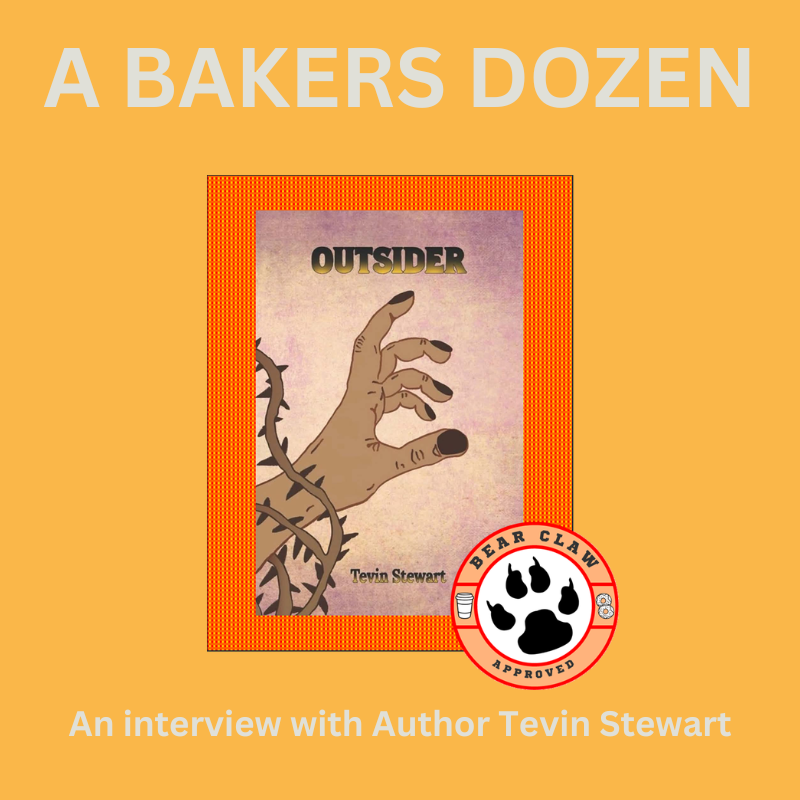
Outsider with Author Tevin Stewart

I'm fortunate that afternoons at the Bear Claw usually run themselves. The muffins are done, the lunch rush has cleared, and Stacy has things well under control. The sunshine of May peeked through the front window of the bakery like an invitation, and rather than head right home, I decided to stretch my legs and take a walk over to B-Sharp.

Sometimes my visits to the vintage record store were to check on Tony. Other times they were because I liked the smell of old records and the quiet that settles over a room when good music is playing softly and nobody is in a hurry. Judging by the number of customers milling about the stacks, it seemed I wasn't the only one with that idea today.

I had only been sitting on a stool beside the sales counter for a few minutes when a young man I didn't recognize approached. Jeremiah, who was stationed in front of the register, was fiddling with the decrepit laptop he'd brought in to help with inventory.

"Do you carry anything by Lana Del Rey?" the man asked.

Tony looked over from his seat next to me, opened his mouth, and then closed it again.

Jeremiah, having given his boss ample time to respond, finally answered.

"She sings Summertime Sadness," he said to Tony, like he was reading from a file. "Born to Die album. 2012." He paused, doing what Jeremiah did best — educate. "In 2023, Rolling Stone named A&W one of the 500 greatest songs ever recorded." He turned to the customer. "Sadly, we don't have anything by her. Most of what we carry is pre-turn of the century. Unless you count Taylor Swift." He stole a glance at Tony and rolled his eyes, obviously not a fan of the pop stylist, or my boyfriend's insistance at carrying her records.

The young man nodded like he'd expected that. "What about Fleetwood Mac?"

And just like that, Tony was given a chance to redeem himself.

"Now we're talking," Tony slapped his knee, and was up and moving towards the classic rock bin. He came back a couple of minutes later with a copy of Rumours and set it on the counter like he was presenting evidence. "1977. If you don't already own this, we need to fix that today."

"I've got that one, a classic, for sure. I was thinking something deeper. Tango in the Night, maybe."

Tony looked at him for a long moment. He then looked at me and then went back to check the bins.

I introduced myself while the man waited.

"Brenda Welch. I'm one of the owners of the Bear Claw Bakery, over on Jefferson Street."

"It's nice to meet you. I'm Tevin Stewart, but you can call me Jessie."

"What do you do, Jessie?" Jeremiah asked.

"I'm a mystery writer," he said.

Hearing that, and seeing the expression on my face, the old man rose from his space behind the counter and decided that Mr. Stewart was in capable hands.

"I have a question, and this is going to sound a little crazy," I said, "but do you have a few minutes to talk about your writing?"

"Talk about my writing? It's one of my favorite subjects. I'm in no hurry."

"Well, I'm a big fan of mysteries, and I've been interviewing authors about their work. How would you like to be the subject of one of those interviews?"

Ten minutes later, after paying for his record, the two of us were walking down Monroe Street toward Mabel's.

"So, tell me about yourself," I said.

"Oh, gosh." He laughed. "I always freeze up when I have to talk about myself. My brain has to reload." He thought for a moment. "I was always the quiet introverted kid who hardly left the house. But, when I did venture outside, you'd find me gallivanting through the sketchy forbidden woods. Like I was looking for vampires, or uncovering a mystery from one of the books I loved."

"That sounds amazing. Do you still do that?"

"No. Now I'm a complete homebody. Video games, working out, dealing with a dog who sticks to me like velcro. Building things. I recently built a gaming PG, and then I had to build a desk to put it on."

"No more woodland adventures?"

He shook his head. "Now I'm like a complete vampire. I barely even open my curtains."

"When did you start writing mysteries? Was it those adventures that inspired that?"

"Actually, it was TV. All those teen dramas from ten or twenty years ago. Even the ordinary high school ones would have these episodes that went somewhere darker. A mystery subplot. Something with real stakes. There was always something about that tone that got to me. They left me wanting more of it."

When we reached Mabel's at the corner of Third and Monroe, I held the door open for him and waved him inside. The restaurant was quiet, as it normally gets that time of day. Clive Hendrix was holding court at the counter, and a couple of retirees were nursing coffee at a table in the back. We settled into a booth beneath an old black-and-white photo of Lake La Pointe from an earlier time. Tevin set the record beside him in the booth just as Marge appeared.

"Hey, Brenda. What can I get you and your friend?"

"Coffee for me, thanks."

"And for you?" she said, looking at Tevin.

"Do you have lemonade?"

"Of course we do. Regular or strawberry?"

Something about the way he answered — "strawberry, please," no hesitation, like it was never a question — made me look at him a little more carefully. I read people in the bakery by their drink orders. This one was going to be interesting.

When Marge left us, I reached into my bag and pulled out the journel I kept for occasions just like this.

"So, tell me, who shaped how you write?"

"Hmmmm. I would say R.L. Stine was an influence growing up. Barry Lyga's I Hunt Killers is incredible, and of course I have to give a nod to the great Stephen King. Carrie has always been near the top for me. The way it shows every perspective. The protagonist, the villain, the people around them,  all circling the same event. I love mysteries that do that. The villain is always the most important aspect, in my opinion."

"I'd have to agree," I said. "A mystery is only as good as what you're chasing. Who is your main character?"

"That would be Peyton Drescott."

"Tell me about Peyton."

He leaned forward a little, the way people do when they're talking about someone they genuinely care about.

"Peyton is an amalgam of a lot of things. She's a teenager who's battling herself. She wants a normal life. She wants to find her mother's killer. And there's this part of her that may actually enjoy the ability she didn't ask for." He paused. "You see, she has telekinesis. TK. And it's connected to her emotions in ways she can't always control. It's like a tug-of-war. Sometimes I think she's talking to a twin. Two versions of herself, pulling in opposite directions."

I looked up from my notebook. "A murder mystery with telekinesis?"

"Subtle," he said. "For now."

Marge came back with the strawberry lemonade and my coffee. Tevin wrapped both hands around the glass like it was exactly what he needed.

"And where does all of this happen?"

"Gresham, Missouri. About thirty minutes outside of Branson." He said it like he was giving directions. "It looks like any other American town on the surface. A vibrant community, where everyone knows pretty much everyone else. You've got your big shots, your local law enforcement, your nosy housewives who gossip about nothing all day." He smiled. "But, just ignore them and check out the beach with the abandoned lighthouse on the edge of the cliff. Stop by Sweet Josie's for one of her freshly baked treats."

It sounded a lot like Flat Rock, except for the lighthouse. But my mind stopped on his last comment.

"A bakery?" I said.

"Of course," he said with a laugh.

"What does Sweet Josie make?"

He thought about it. "She seems like a pie person."

I approved of that.

"Where do your plots come from? Do you know who did it before you start writing?"

"All of my plots come from a mixture of fictional things and things I've actually witnessed in reality." He picked up his lemonade. "I probably shouldn't say too much about which was which. But yes, I knew who Marley's killer was going to be before I wrote a single word. The scenes, the clues, well, those I figured out as I went."

"I haven't read your books yet, but I'm downloading Outsider the minute I get home. Tell me...what's one thing that will surprise me?"

"I think you'll be intrigued by the murder mystery being intertwined with something supernatural. The telekinesis is subtle in this first book, but as the series progresses, the suspense of it is going to grow. I'd be curious to hear what you think of it."

"Oh, I'll let you know, for sure. So, do you write every day? What does a regular writing day actually look like for you?"

He smiled as he considered the answer. "A lot of procrastination while sitting in front of my computer. I'll look at the screen and randomly pay attention to a thousand other things before I finally write one word. And that's just on my days off." He shook his head. "You can consider that my toxic trait."

"We all have them," I said. "Mine is waking up at ungodly hours to make bear claws."

"See, that's not toxic, that's discipline. What I have is the intention of discipline."

"In your books, who is a character you have a soft spot for? Like, one that maybe your readers just don't fully understand yet?"

"Principal Drake," he said, without hesitating. "He'll probably come off to most people as mean and bitter. Very one-dimensional on the surface. But, I think there's something more to him. A softer side he hasn't shown anyone yet." He paused. "I find him funny, honestly. I'm looking forward to seeing where is character goes."

Marge came by and refilled my coffee without being asked, then disappeared into the back.

"What are you reading right now?"

"I need to catch up, honestly. I'm getting into You Shouldn't Have Come Here, a horror graphic novel called GremoryLand, and an indie slasher called Tastes Like Candy, by Ivy Tholen."

"Indie slasher, huh?" I repeated.

"It's good. Dark, but good."

"I've found that the best writers are the ones who can identify what makes a mystery truly satisfying. Not just good in a storytelling sense, but genuinely satisfying. What does that mean to you?"

"I love mysteries that plant seeds. Clues and suspense in real time. I want to find things out and theorize alongside the characters, not just be told what happened. It needs to unfold in a way that makes the lightbulb go off in your head." He tapped the table lightly. "That moment when everything clicks. That's the whole thing, right there."

He picked up his lemonade and drained the last few drops, the ice shifting back and forth in the glass. I stuffed my notebook back into my bag and pulled out cash for our drinks, leaving a hefty tip for Marge and sliding the bills under the ketchup bottle on the table.

"Last question. If Peyton walked into my bakery right now and ordered something, what would it be and why?"

He answered immediatly.

"Strawberry cake. Strawberries were her favorite thing as a kid. She used to eat so many that the juice would stain her shirt. Someone she loved, a man who was like a surrogate father to her since she grew up without one, used to call her Strawberry because of it."

I looked at the empty strawberry lemonade glass sitting in front of him.

He smiled. "I know," he said. "I know."

We got up from the table and made our way outside into the sun.

"What's next?"

"Books two and three are already on the way. Peyton gets closer to uncovering Marley's killer. Nothing is what it seems with several of these characters, and we'll learn a lot more about who Marley Harvey actually was. As a friend, a daughter, a lover, and a mother." He paused. "And Peyton's ability is going to progress as she comes to terms with it. She can't keep the lid on it forever."

I shook his hand, thanked him for his time, and then watched as he walked back towards the record store. I crossed the street and walked down Third Street. It was time to get home with my journel full of notes and order a new book for my To Be Read pile.

Not a bad afternoon.


Tevin 'Jessie' Stewart writes the OutSider Saga. Book One, OutSider, is available now on Amazon. Find him on Threads, Instagram , Facebook, and on TikTok.

Bear Claw Approved.


Are you a mystery author with a story to tell? Brenda would love to hear it. Reach out to Kevin at kevin@kevinzelenka.com and let's talk.

Open post

A Serial Killer’s Cookbook with Author Stacey Roberts

I wish I was tall. Not all the time, mind you. Just moments like today, when I was balancing precariously on a stepstool on my tiptoes. The bakery had an order come in for fifteen dozen cookies for a teacher's appreciation event at the grade school. There was no way we'd be able to fill the request without the extra sheet pans I kept on top of the rack on the back wall. This was the reason my four-foot-something body was doing a balancing act that would have made Cirque du Soleil proud. I'd been after Tony to stop by and help since the order came in, but he'd been buried in his own organizational issues in the back room of his record store. So here I was, genuinely weighing the odds that today was the day I finally broke something, when I heard a strange voice behind me.

"Need a hand with that?"

"Sure," I said, looking at the bespectacled man standing behind me. I descended the ladder and the man climbed up, taking my spot.

"Which ones are you after?" he asked.

"Just the sheet pans. There should be six of them."

"There's five," he answered.

"Having five beats not having any. I appreciate it. Mr…."

He carefully moved down the small A-frame ladder, pans in hand. "Stacey."

"Well, thank you, Mr. Stacey."

"It's Mr. Roberts. Stacey is my first name."

"Oh, what a coincidence. My business partner is a ‘Stacy’ too. But she's — well, a girl."

"I know, we met. She was busy with customers, and after either sizing me up for threat or for a tuxedo, she sent me back here. My name has an 'e' in it."

I took the sheet trays from him and slid them onto the prep counter. "So, how can I help you, Stacey with an 'e'?"

"I write the Madison Mysteries, and you commented on my book that if I was ever in Flat Rock, I should stop by and let you interview me for your Baker's Dozen series."

"That certainly sounds like something I would say." I gave him a quizzical look. "I read a ton of mysteries. I'm trying to place your…"

"A Serial Killer's Cookbook."

"Oooooooh," I said, it suddenly hitting me. "Amelia Stark. I loved that book." I shook my head. "Sorry — I guess I just hadn't connected it to the series name yet."

"Well, in your defense," he said, "I haven't written any more in the series yet. But I'm working on it."

"Then we have a lot to talk about. Let's grab a table and I'll get my notes."

We made our way back up front, with Stacey settling into the window table, while I retrieved my tattered writing journel and pen from under the counter.

"So, where are you from?" I asked, sitting down across from him and flipping open my notebook.

"I live in Northern Kentucky, just outside of Cincinnati”

"Wow, so not exactly a local. How did you find your way up to our tiny little lake town?”

“I was up in Minneapolis for a conference and thought — well, it's not that far. And you had made the offer, so..."

"I did," I said. "And I meant it." I clicked my pen. "Alright then, Stacey, tell me a little about yourself. Who are you when you're not writing?

"Well, I own my own business, which takes up most of my time. I have two Goldendoodles — Gus and Sally — and two cocker spaniels.” He paused. "Sally's a boy, by the way."

I looked up from my notebook. "Sally is a boy."

"Like me," he said, perfectly straight-faced. "A boy with a girl's name."

I wrote that down. "Go on."

"I'm a big history and politics nerd, so I spend a lot of time reading and writing in that area.”

“If you like history, you’d love it here. There’s a lot of history in and around Flat Rock,” I told him.

That was the moment Stacy showed up. Customers apparently handled, or close enough. She had a look on her face I recognized.

"Can I get you something?" she asked, directing this entirely at my new author friend.

"What do you recommend?" he asked.

I looked at Stacy. "He'll have an iced chai latte," I said, before he could finish the thought.

He blinked. "That's — actually exactly what I was going to order."

I read people by their coffee order. It's a gift.

Stacy wrote it down, and then leaned on the table, batting her eyelashes at him. "I'm sorry, I didn't catch your name."

“This is Stacey Roberts," I said. "He writes the Madison Mysteries. I'm interviewing him for the Bear Claw Approved Authors series. Stacey – meet Stacy."

"Oh, how fun," my partner said, and then, as casually as she could, "Are you married, Stacey?"

"I am,” he said.

I watched the corners of Stacy’s grin drop just a little. "Good for you," she uttered, and went to make our drinks.

And I continued with the interview.

“When did you know you wanted to write mysteries? I mean, was there a book or a moment that made you think, ‘yeah, this is what I want to do’?”

The author shifted in his seat. "They always say that you should write the book you want to read. I grew up reading Robert B. Parker's Spenser novels, and lately the Jack Reacher series. I love a good mystery. It just made sense to write one."

“That does make sense. So Parker, and Lee Child. Both great authors. Any others?

"Sue Grafton.”

No hesitation. I respect that in a person. I shook my head. “I loved Grafton. I once bought 'G is for Gumshoe' at a garage sale. I was hooked after that, and have been following her series for decades. So tell me about Amelia Stark, the lead character in your book. Is she like Kinsey Millhone, from Grafton’s Alphabet Murders?”

"Maybe a little,” He answered. “Amelia Stark is an amalgam of all the badass, independent women I've known in my life. She's a recovering alcoholic, a recovering spouse of a dim and selfish man-baby, and a single mother to a brilliant prodigy. Her life's mission is to protect and care for him and make sure he doesn't turn out like his father. And grandfather. And great-grandfather. She wants, above all, to live her life quietly." He smiled. "Unfortunately, events turn against her."

"As they tend to," I said.

Stacy sans the extra 'e' reappeared with my usual coffee and the iced chai latte. She set down our drinks with a smile, and then looked at our guest.

"You said you were married. Would that be happily?"

"Stacy...," I said.

"Just asking." She disappeared back to the counter.

The writer Stacey watched her go. "Is she always like that?"

"More or less," I said. "You get used to it. You were telling me about Amelia.”

"She’s an independent woman in small-town America, owns a vast amount of land, and has money that's only one generation old. She's an unmarried single mother. The provincials look askance at her — especially when people she knows start turning up dead."

“And all of this happens in Madison, Indiana?”

“Yep.”

“So why Indiana? Why not Kentucky or Ohio…or even Minnesota, for that matter?”

"Madison, Indiana is a jewel of a river town I stumbled across twenty years ago. The downtown area feels frozen in time. There's an air of nostalgia and simplicity that we don't get much of anymore. But since it's the world of my mystery series, a lot of things happen there to make it interesting."

"Sounds a little like Flat Rock," I said.

He looked around the bakery. "A little," he agreed.

“And your plots,” I asked. “Where do they come from? Do you know who did it before you begin writing, or do your character tell you?

"I make stuff up." He said, like it was the most obvious thing in the world. "This one started when I found a recipe book from the 1950s in an antique store. So many Jell-O molds.”

I couldn’t help but laugh.

‘As with most of my ideas,” he continued, “it ended up with 'and then the murders began.' So, I imagined Amelia as a single mother who finds her aunt's old recipe book and decides to start cooking for budgetary and health reasons."

He leaned forward a little.

"There was also a post on Facebook once about recipe sites. You know the ones, where there are sixteen pages about how they came up with the recipe?  Before they get to the actual cooking?”

“Oh, yeah, I know…” I said, worried that maybe the intro to my peach cobbler ran a little long.

“Someone on social media commented: What if a serial killer hid the clues to thier murders in the preamble to recipes, because no one ever reads that part?"

I set my pen down. "That is either the best or the most unsettling thing I've ever heard."

Roberts took another sip of his latte. “To answer your original question, I usually know who did it before I start," he continued. "My next Madison Mystery is about the JFK assassination, and I know who did it." He paused. "It's not who you think. The parts that get made up as I go are usually characters that I didn't plan, or scenes that grew organically. Like, the chapter from A Serial Killer's Cookbook with the meat fork."

I made a note: read the meat fork chapter again. “So, if my readers pick up your book for the first time, what should they know beforehand?”

"It's pretty funny," he said. "For a murder mystery."

“I’d have to agree, though it’s been awhile since I read it. I’ll have to go back and read it again,” I said, pointing to the bookshelves that lined the hallway heading back to the bathrooms.

“You’ve read all of those?” Stacey asked.

“That’s just part of my collection. I have seven or eight shelves just like those at home, full. Not bad for someone who only gets a chance to read now before bed. I’m up at four a.m. every morning to begin baking. Are you a morning or evening writer?”

"I have to start early. I'm a morning person — up at four-thirty — so if I'm going to write, it has to be early. I run out of steam before noon."

“That sounds familiar. I get more work done before noon than most people do all day. But then, it’s mostly because the croissants aren’t going to make themselves. I respect the discipline either way. Hard work builds character. Speaking of characters, is there a character in your books that you get excited to write about?”

"Gene Four," he said, without a moment's hesitation. "I love that kid."

I looked up. "Gene Four. Amelia's son, right?”

“Yes! He's twelve, is a prodigy, and gives his mother completely unhelpful advice about Roman emperors and murder motives."

"He sounds like someone I'd like," I said.

"Most people do," he said. "That's kind of the point."

I looked over and saw my lovesick business partner watching the two of us. If I didn’t wrap this up soon, I could just see her coming over and attempting to try and talk Stacey into moving here. “So, what are you reading right now? Any good mysteries? Or anything that is influencing what you're currently writing?”

"I just finished Remarkably Bright Creatures, I'm working through The Hail Mary Project, and I'm reading a biography of Mark Twain.”

“Samuel Clemens,” I playfully corrected. “I love Mark Twain. We have a playwright here who is working on a production of his visit to our fair town.”

“That’s incredible. He really came to Flat Rock?”

“No,” I said, “but her play is going to say that he did. She’s asked me to be her understudy.”

“You should do it. His book is the only one that influences my writing." He paused. "Other writers inspire me to keep going. The Twain book reminds me what's possible."

“There’s something satisfying about getting that type of inspiration from a writer. What else, would you say, makes a book satisfying?

He thought about that for a moment, which I appreciated. People who answer too fast haven't really considered the question.

"Most of my favorite mystery books, the Spenser novels, for instance, are never really about who did it. Discovering the killer is not the point of the book. It's the characters. Stephen King and Robert B. Parker had a gift for creating characters you just want to follow around and see what they do next. If they happen to be hunting a killer or doing battle with a possessed car, that's interesting. But it's the character you want." He picked up his latte. "Sue Grafton and Janet Evanovich do that exceptionally well."

I wrote that down slowly. Partly because I wanted to think about it. He wasn't wrong. I also didn’t want the interview to end.

"We’re getting near the end of the questions, and for as much as I hate it, I have cookies for kiddies I need to start baking. I do need to ask you something, and it’s something I ask everyone. If Amelia walked into my bakery right now and ordered something, what would it be and why?”

"A cinnamon bun with extra icing," he said. "Because she's been cutting back on sugar."

I liked that answer very much.

We both stood, and the two of us made our way to the doorway. As we walked, I asked, “What's next for you and your series? What should readers be watching for?”

"Well, Amelia is going to be hot on the trail of a new serial killer in my next book.”

“And we can expect more of Gene Four, I hope?”

“Absolutely!  I'm also working on a Madison Mystery set in the same world — many of the same characters — but in this one the hero is a former one-term Vice President who, in his depressed retirement, stumbles over a new 9/11 plot. No one in government is taking his calls. His party got shut out when they lost re-election, so he has to try and solve it himself. With his trusty recovering alcoholic of a Secret Service agent."

I stared at him for a moment. "You have a lot going on up there."

"It's a gift," he said. "Or a problem. The Jury's still out on which."

I opened the door. Jefferson Street was doing its usual mid-morning thing.

"You know," I said, "you didn't have to drive all the way up from the Cities just for this. I really appreciate it."

"You'd be surprised how far I'd go for a good chai latte. Madison, Indiana to Minneapolis is a long way. My hotel in the Cities to Flat Rock was barely a detour." He smiled. "Besides. You made the offer."

I had. And I meant it. My Stacy gave the man a sad little wave goodye as he stepped through the doorway and out into the sun.


Stacey Roberts writes the Madison Mysteries series. A Serial Killer's Cookbook is available now. Find him at staceyroberts.net, on Facebook, and on Goodreads.

Bear Claw Approved.

Are you a mystery author with a story to tell? Brenda would love to hear it. Reach out to Kevin at kevin@kevinzelenka.com and let's talk.

Open post

Murder in the Mix with Author Carolyn Eichhorn

I can’t believe that I was twenty minutes late to my own interview. In my defense, the Halversons' three-tier wedding cake wasn't going to deliver itself, and the rain that started somewhere around eight that morning had no interest in stopping for anyone's schedule. To add insult to injury, I'd made it back downtown and got stuck behind Herb Grissholm, cruising down Jefferson Street on his Lawnmower. The old man lost his driver's license sometime last fall after the Twins played a doubleheader and the Prohibition Bar and Grille had cold beer and a comfortable barstool. Herb, being a practical man, obviously decided that a lawnmower was a reasonable alternative to a car. I can’t wait to see how law enforcement weighs in on this.

I pushed through the door of the Bear Claw Bakery, shaking rain off my jacket, and found Carolyn Eichhorn, the subject of my interview, already settled at the table by the window with something warm in front of her, courtesy of Stacy, who gave me a look that said you're welcome and you're late in equal measure.

"I'm so sorry," I said, hanging my jacket behind the counter. "I got stuck behind… well, it doesn’t matter.”

Carolyn smiled. "Stacy took good care of me."

"She always does," I said. "It's her best quality and her most annoying one."

I settled into the chair across from Carolyn, wrapped both hands around the coffee Stacy had already set at my place, and took a breath. "Alright," I said. "Where to begin? Let’s start with you. Tell me about Carolyn.”

The author didn't have to think about it long. "Well, I’m a project manager, dateline junkie, and restaurant enthusiast.”

“OK, so going out, hitting the town…”

“Actually, I’d say I’m more of a homebody." She paused. "I love bookstores, cooking, spending time with my boyfriend..." Another pause, this one with some weight to it. "And not camping."

I looked at her and laughed. "Not camping?"

"Specifically, and emphatically not camping."

"I respect that more than I can tell you," I said. “The only camping I want to do is at home with a great book.”

“It sounds like the perfect adventure,” Carolyn responded.

“So, what adventure led you to mysteries?”

"Nancy Drew," she said, without hesitating.

“Oh, I loved Nancy Drew!”

“But that's just where it started. Then came Agatha Christie. She taught me something I've never forgotten. How to find the crucial clue in a sea of distractions. How to look at everything and know what actually matters."

"That sounds like more than a writing skill," I said.

"It is," she said. "Uncovering hidden truths. Finding solutions. Those things are applicable to life. Not just mysteries."

I thought about that for a moment. I have spent enough years in this town to know that she was right.

“O.K., so, who else? Is there anyone who you feel helped shape your writing?”

“I guess I’d say Stephen King, for point of view. He taught me that you could move between perspectives in the same story and make it work. That became a piece I wrote called Thalassotherapy that actually won first place in Rehoboth Beach Reads."

She smiled at the memory of accomplishment. "I also like Karin Slaughter, because her mysteries aren't just puzzles. They connect viscerally. You feel them." She paused. "And Harlan Coben. Because just when you think you have it figured out —"

"You don't," I said.

"You absolutely do not."

"Tell me about Gina," I said. "She’s a writer too, yes?”

"Yes, a ghostwriter," Carolyn said. "She's spent years hiding behind her keyboard, working on other people's projects, and I think time has just slipped by while she wasn't paying attention. She's been so busy telling other people's stories that she's lost track of her own." She paused. "It takes a series of disruptions to shake her loose."

"What kind of disruptions?" I asked.

"Well," Carolyn said. "In Murder in the Mix, she agrees to write the memoir of a celebrity chef named Marisol St. James. She's expecting high-pressure deadlines and diva behavior." A beat. "She gets murder instead."

"That would shake most people up," I said.

"It does the job," she agreed.

“So, your ghostwriter, tell me about her world.”

"Gina's work puts her inside other people's lives," she said. "In this book, that means the restaurant world. The kitchen culture, the rivalries, the secrets that simmer underneath a beautiful menu." She paused. "And then there's the writing world. The spaces she shares with her friend Mark, who is a mystery novelist."

"Is Mark good company?" I asked.

Carolyn smiled. "Mark is great company. He's a mystery writer, but…" she paused, "considerably cooler than I am."

"I find that hard to believe," I said.

She laughed. "He'd appreciate you saying that."

"A question I always ask is about a writer’s process. I mean, some write all willy-nilly, while others have a strict outline. How do you plot?" I asked. "Do you know who the murderer is before you sit down, or do you find out as you go?"

"I usually have the broad strokes before I start," she said. "The shape of it. But I try to stay open to surprises, because they happen whether I plan for them or not. Ideas are everywhere." She shook her head. "I have to scrawl them down the moment they come, or they're gone. A good line, something that strikes me in a particular way. Then I find a way to work it in."

"What should readers know before picking up Murder in the Mix for the first time that might surprise them?" I asked.

"A few things." She leaned back in her chair. "Gina has her own voice, her own point of view. That view is often very different from her clients. So, readers get to hear Gina, and then Marisol, and then Marisol as written by Gina. Three layers." She paused. "And Marisol's recipes are included."

I set down my cup. "The actual recipes?"

"The actual recipes."

"From a celebrity chef."

"From a celebrity chef," she confirmed. "Who, granted, is fictional. But the recipes are real."

I appreciated that more than she probably knew and wondered if celebrity chefs ever made peach cobbler.

"You told me that you’re a project manager. How do you find time to write every day with a regular nine-to-five?”

"Actually, I don't write every day," she said, in the tone of someone who has made peace with this. "I need enough time to get into my groove, and that's hard to find at home. I like libraries. Coffee shops." She glanced around the Bear Claw. "Places where I can focus without interruptions."

I made a mental note to mention that we opened at six every morning.

"Is there a character in your books that you have a soft spot for?”

"Mark," she said, immediately. "Gina's friend. The mystery writer." She smiled. "I really like him."

"Cooler than you," I said.

"Considerably," she said. "But I made him, so I'll take some credit."

"Credit deserved. So, being a reader and a writer, what makes a mystery satisfying to you?" I asked. "I mean, not just a good one in a reading sense, but truly satisfying.”

She didn't hesitate. "Justice," she said. "It doesn't have to be conventional. But bad people shouldn't get away with it. The feelings you had in your gut while you were reading, they should be justified. Good people should try to make things right." She paused. "That's what I need at the end of a mystery. That feeling that the world, at least in these pages, is a little fairer than it was at the beginning."

I sat with that for a moment. It was a good answer. Tony would like that answer.

"Last question, and I ask everyone this…" I said, "If Gina walked through the door of the bakery right now and went up to the counter, what would she order?"

Carolyn smiled. "A cranberry orange muffin, warmed. And a good cup of coffee." She paused. "Gina is fond of a good muffin."

"Then, Gina," I said, "Is welcome here anytime."


Murder in the Mix is Book One in the Gina Morrison Mystery series. Find Carolyn at carolyneichhorn.com and on Instagram, Facebook, Threads, and Goodreads.

Are you a mystery author with a story to tell? Brenda would love to hear it. Reach out to Kevin at kevin@kevinzelenka.com and let's talk.

Open post

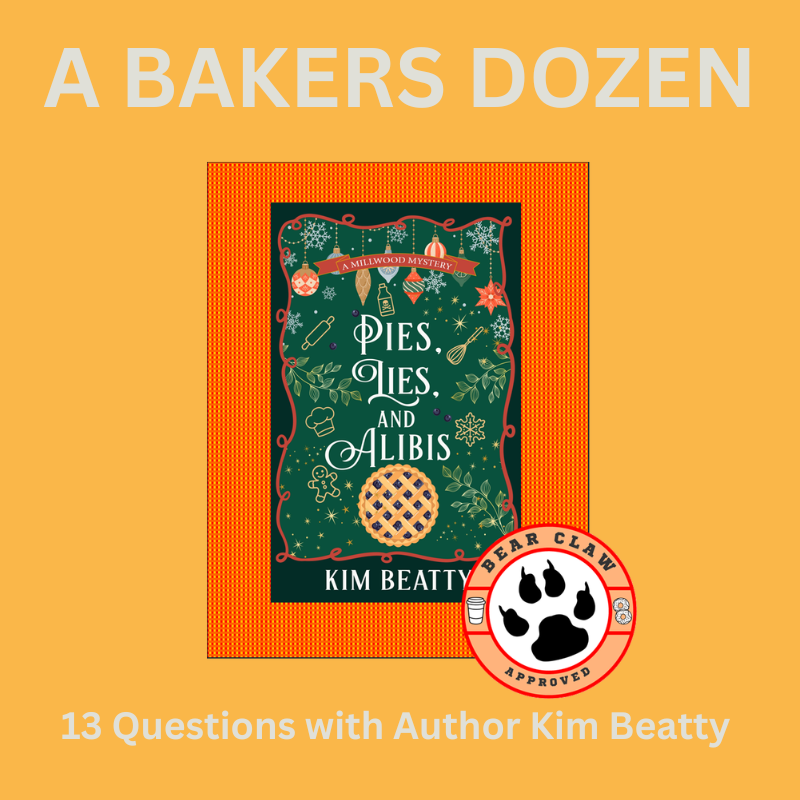
Pies, Lies, and Alibis with Author Kim Beatty

I'll be honest with you about something before we start.

When Kevin asked me to sit down with authors and write about them, I said yes before I fully understood what I was agreeing to. That's a habit of mine that Stacy has been trying to break me of for years. Just look at our Special-Order clipboard for proof. But then Kim Beatty walked through the door on Tuesday morning, and her smile lit up the room in a way that had nothing to do with the overhead lighting I keep meaning to upgrade. That’s when I thought, "Alright. I understand this now.”

She ordered one of our signature bear claw and a white chocolate mocha, which gave me some clues as to who I’d be spending the next hour with.

“Milk?” I asked.

“Oat milk, if you have it. But I don’t want to be a bother.”

Stacy pushed me aside and made a shooing motion at us with her hands.

“No bother at all. I’ve got you covered. You two go get settled.”

I led the way to the table by the window and gestured at the chair across from me. “So, while we wait for our drinks, tell me a little bit about you," I said. "Not the author version. The real one. I want to know who you are when you're not writing?"

Kim didn't hesitate.

"I’m like three over-caffeinated raccoons in a trench coat."

I set down my coffee cup and stole a glance at the back of the bakery. We’d had a problem with the furry beasts invading our dumpster, and just hearing the ‘R” word put me on edge.

“How so?” I asked, cautiously.

"Too much caffeine," she continued, perfectly comfortable with what she'd just said. "Not enough vegetables. Staying up too late reading."

I looked at her for a moment. "That's the most honest answer anyone has given me to that question."

"I find honesty easier," she said. "Less to keep track of."

I liked her immediately.

Stacy brought over our drinks, and I thanked her and dug back into the questions.

"When did you know you wanted to write mysteries specifically?" I asked. "Was there a book, or a moment?"

Kim thought about it. "I've always loved a good whodunnit. You know…true crime, thrillers, all of it. But cozies were what finally made me actually sit down and write one." She wrapped both hands around her coffee mug and licked a dollop of the dairy-free topping. "I needed a break from the darker stuff. And there's just something about a cozy. Something comfortable and familiar. Like, you already know the town before you get there."

"Like coming home," I said.

"Exactly like that. A co-worker had said something that lit the spark. Pies, Lies, and Alibis was born from that conversation.”

“What did they say?" I asked, curious.

She smiled. "Honestly? I don't even remember the exact words anymore. But it was something that clicked."

I understood that. Some of the best things start that way.

"Tell me about your main character," I said. "I did a little bit of research. Kendall Howard. What makes her tick?”

"Well, she owns a bakery called City of Pies," Kim said. "She's in her forties, has ADHD, and she's getting to experience the best and worst of being a woman of a certain age." She paused. "She's sarcastic. Very sarcastic. It's been a defense mechanism for so long that she has a hard time turning it off."

I turned and looked at Stacy, who was wiping down the espresso machine behind the counter, pretending not to listen.

Ms. Sarcastic herself looked back at me and grinned.

"She wears band t-shirts and flannel," the writer continued. "All the time."

I thought of Tony’s employee, Jeremiah, and was about to ask if Kendall had an older brother who lived here in Flat Rock, and then decided against it.

"What does she do when she needs to think?" I asked. "When something's bothering her, and she needs to work it out?"

Kim looked at me like the answer was obvious. "She bakes."

"Of course she does," I said.

"It's the only thing that works," Kim said. "Give her a task, something real to focus on, and her brain sorts everything else out underneath it."

I have been saying this exact thing for years. Nobody in my life has ever fully believed me. I'm considering having it embroidered on something.

"Describe your setting, Millwood, to someone who's never been there. Is it like Flat Rock?"

Kim leaned forward slightly. "It's a small Midwestern town, probably pretty similar to here. Except it’s somewhere in the Northwestern Indiana and Chicagoland region. I always describe it as close enough to the city to take the train but small enough that everyone knows your business before you do."

“Well, that part is definitely like Flat Rock,” I quipped.

My interview subject stifled a laugh. "The heart of it is Mill Street. Historic shops on both sides. A vintage shop, a hardware store that's been in the same family for at least seventy-five years, a hobby shop, a floral shop, an Irish pub."

"And Kendall's bakery," I said.

"And Kendall's bakery. Which shares a building with a bookstore called Pack Up The Books. Her best friend owns it."

I set down my cup. "A bakery," I said slowly, "and a bookstore. Under one roof."

"Dream setup, right?" She glanced at the bookshelves I had Mason from White’s Hardware build for me that lined the hall leading back to the bathrooms.

I wasn't able to respond right away. I was picturing it. What if all of the walls here were bookshelves…and the books were for sale instead of just to borrow? I quickly pushed the thought aside for now and continued.

"How do you plot?" I asked, regaining my composure. "Do you know ‘who did it’ before you start writing, or do you figure it out as you go?"

She gave me the look of someone who had been asked a perfectly reasonable question they found slightly painful. "I am really bad at planning things," she said. "Like…genuinely bad. I have every intention of following an outline, and then I sit down and just…go."

"And?"

"Sometimes the characters know what's going to happen before I do," she said. "They take matters into their own hands. My original draft of this book is completely different from what ended up published."

"Did your characters know the story better?" I asked.

She smiled. "Probably. They usually do."

The writer took another sip of her mocha. “This is really good!” She said.

“Are you surprised?” I asked

“No, not at all. And it goes with your bear claw perfectly.”

“People learn that everything goes well with our bear claws. Speaking of surprises, tell me something that readers who haven't picked up your book yet might be surprised to discover?"

"Hmmmm. I guess I’d say that the people who already know me — from real life or from following me online — will probably recognize a lot of me in Kendall." She gestured at herself. "It wasn't intentional. It's just what happens when you write what feels natural."

"The band t-shirts?" I said.

"The band t-shirts," she confirmed. "The sarcasm. All of it."

"O.K., here’s a question. I’m up at 4 am every day. What does a writing day actually look like for you?" I asked. "Be honest."

She laughed first, which I took as a good sign. "I don't have a set schedule. I write when it feels right, and if it doesn't, I don't push it. I wander between rooms. I play a silly game on my phone to clear my head." She paused. "On good days, I take my laptop outside."

"And on days when the writing itself isn't cooperating?"

"I work on other book things," she said, and looked at me with a smile. "Like a lovely author interview."

"I'm glad I could help. Wait until you try my peach cobbler." I said.

Then I leaned forward. "So, I read a lot and have developed some favorite characters over the years. Is there someone in your books — maybe not the main character — that you have a soft spot for? One that readers might not expect?"

She considered me across the table for a moment. "That might give away some spoilers."

I have been keeping this town's secrets for a long time. One more wouldn't trouble me. But I appreciated the loyalty.

I thought for a moment about my next question. "What do you think makes a mystery satisfying?" I asked. "Not just good. But truly satisfying."

"The subplots," she said, without missing a beat. "The romance, the character growth, the small relationships building in the background. If those feel off, the whole story feels off. Even if the mystery itself lands perfectly." She paused. "Does that make sense? Maybe I need more coffee."

"It makes complete sense," I said. "It's the trail you follow between the big moments. That's what keeps you walking."

She pointed at me. "Yes. Exactly that."

"Last question, I swear," I said, "If Kendall walked through my door right now and walked up to the counter, what would she order?"

Kim didn't even have to think about it. "She'd look for pie first. That's always first. If there's no pie, she goes for a scone or a muffin. And coffee, always, if it's available." She paused. "She'd never say anything critical out loud. But her inner monologue would be going a mile a minute, comparing every bite to her Gran's recipes."

"She sounds," I said, "like someone I'd enjoy having at this table."

Kim smiled that smile that I said lit up the room when she first walked in, and I meant every word of it.


Pies, Lies, and Alibis is Book One in the Millwood Mystery series. Book Two is coming soon. Find Kim at kimbeattyauthor.com and on Instagram at @thepeachmartini.

Are you a mystery author with a story to tell? Brenda would love to hear it. Reach out to Kevin at kevin@kevinzelenka.com and let's talk.

Scroll to top