
Chapter 1
The Slim Whitman record had come in on Tuesday, tucked between a reissue of Ambrosia’s One-Eighty and a copy of Herb Alpert's Whipped Cream that someone had special-ordered a month ago and never picked up. I'd set it aside behind the counter with Marveen Huppert's name on a Post-it note, and called to let her know it had arrived.
She came in Friday morning, a little after we opened, still wearing her coat, which told me she'd walked over from the post office rather than driven. Marveen lived about six blocks north of the business district — close enough to walk when the weather cooperated, far enough that she usually drove when it didn't. October in Flat Rock, Minnesota, was a coin flip.
"Morning, Marveen," I said, already reaching behind the counter for the record.
"Tony." She set her purse on the counter and started fishing for her wallet. Normal so far. Marveen Huppert was the kind of woman who had her money ready before the total was rung up. It was one of the things I'd always liked about her.
I rang the album up while Jeremiah moved quietly along the far wall, sliding albums back into their slots with the methodical patience of a man who had strong opinions about alphabetical order and wasn't shy about enforcing them. He glanced over when Marveen came in, gave her a brief nod, and went back to work. Jeremiah respected Marveen the way you respect a neighbor's fence. He acknowledged it was there but had no particular interest in engaging with it. I suspected it was because she thwarted his attempts to buy anything other than the music she was interested in. My sole employee had a bad habit of attempting to convert my entire customer base into Heavy Metal fans. The fact that someone could walk in looking for Frank Sinatra and walk away with Black Sabbath was proof of his salesmanship.
Marveen paid, and I bagged the record, sliding it across the counter. She tucked it under her arm.
And then she just stood there.
I waited, because people often had questions. Sometimes they just needed a second.
"Nice day out," I offered.
"Mm." She glanced toward the window, though I got the feeling she wasn't really looking at anything. Something was working behind her eyes. That particular expression of a person who has come in for one thing and is trying to decide whether to say another.
Curiosity got the better of me. "Everything alright, Marveen?"
She looked back at me. Pressed her lips together and looked down at the glass counter.
"Tony," she said carefully. "Are you aware of what Alice Fenner has been doing out on County Road G?"
I wasn't, and told her so.
Marveen nodded slowly, as though confirming something she'd already suspected. "She's been painting things," she said. "On her outbuildings."
"Alice paints?"
"Apparently." The word came out clipped. "Animals."
I waited.
"On the chicken coop," Marveen continued. "Facing the road." She paused again. "It's very... visible."
I could almost hear Jeremiah’s record sorting in the bin behind her begin to slow.
"Visible how?" I asked.
Marveen's jaw tightened. She set her purse down again, which told me we were going to be here a while. "Visible in a way that is not... appropriate. For a public road." She folded her hands on the counter. "There are families on that road, Tony. Children who ride the bus."
"What kind of animal are we talking about?"
"A goat," she said. And then immediately, as though the word itself had opened a door she wasn't ready for, she added, "but painted in a way that is... suggestive."
"Suggestive."
"Of certain..." She paused. Her eyes drifted briefly toward the ceiling. "Certain anatomical... features. That one would not expect to encounter on a public road. On a chicken coop." She straightened her coat collar. "In broad daylight."
The sorting had stopped completely.
"Marveen," I said carefully, "can you be a little more specific about what—"
"Penis?"
Marveen Huppert made a sound I had never heard a human being make before and have not heard since. It was somewhere between a gasp and the noise a screen door makes when it's caught by the wind.
Jeremiah had materialized at my elbow at some point in the last thirty seconds. He was holding a copy of Boz Scagg’s Silk Degrees that he apparently still intended to file in its correct spot, and he was looking at Marveen with the calm, clinical expression of a man who genuinely did not understand what the problem was.
"That's what you're describing," he said. It wasn't quite a question.
"Jeremiah."
"She's describing a goat that has a—"
"I got it," I said.
"I'm just clarifying."
"You've clarified. Why don’t you go in the back and go through the vinyl we received yesterday?” I told him.
He looked at me, then at Marveen, then back at me. “No problem. Maybe I’ll go to the bathroom while I’m back there. You know…with my penis.”
Marveen had gone the color of a radish. She gripped the edge of the counter with one hand and set her bag, with the Slim Whitman record inside, on it.
"Her neighbor, Betty Lindahl," she managed, after a moment, "is very upset. She called me. She could hardly speak."
"I imagine."
"Something needs to be done."
"Well, honestly, there’s not much I can do," I said, though I wasn't entirely sure what that meant yet.
“It’s already being done. Betty told her son. He’ll make sure it’s addressed properly.”
Betty’s son was John Lindahl, the town’s mayor, and an all-around nice guy. Unless someone was painting obscene goats on chicken coops, apparently.
“I’m sure he will,” I said.
Marveen nodded, collected herself with the dignity of a woman who has navigated worse, and turned toward the door. She took four steps before I called after her.
"Marveen."
She stopped.
"Your record?"
She came back, took it without a word, and left. The bell above the door chimed once behind her.
I stood at the counter for a moment. From the back of the store, Jeremiah shouted, "Slim Whitman."
"Yeah."
"There's no helping some people."
I wasn't sure if he meant Marveen or Alice Fenner. Possibly both.
Chapter 2
Third Street headed east out of downtown, becoming County Highway 212 just past the high school. It’s what carried travelers past the new Walmart and onto the main artery connecting Flat Rock to the rest of the world. Three county roads branched south off 212, each one dotted with farms, old and new. Brenda rented an old farmhouse on County Road D, the first road you'd hit heading east. F came next, then G, where Alice Fenner kept her farm and her chickens and, until recently, her artwork. If there was a County Road E somewhere in between, I had never seen it.
I made the turn heading south. The road curved gently through a corridor of bare October trees before straightening out along a stretch of farmland that made you feel like you'd driven further from town than you actually had.
On the north side, larger operations sat well back from the fence line. Steel posts and wire, neat and functional, the kind of fencing that meant business, with long manicured gravel driveways. The farms on the south side told a different story. Smaller parcels, closer to the road, wood post fences that leaned and listed at conversational angles, held together by the kind of optimism that keeps old fences standing long after they should have quit.
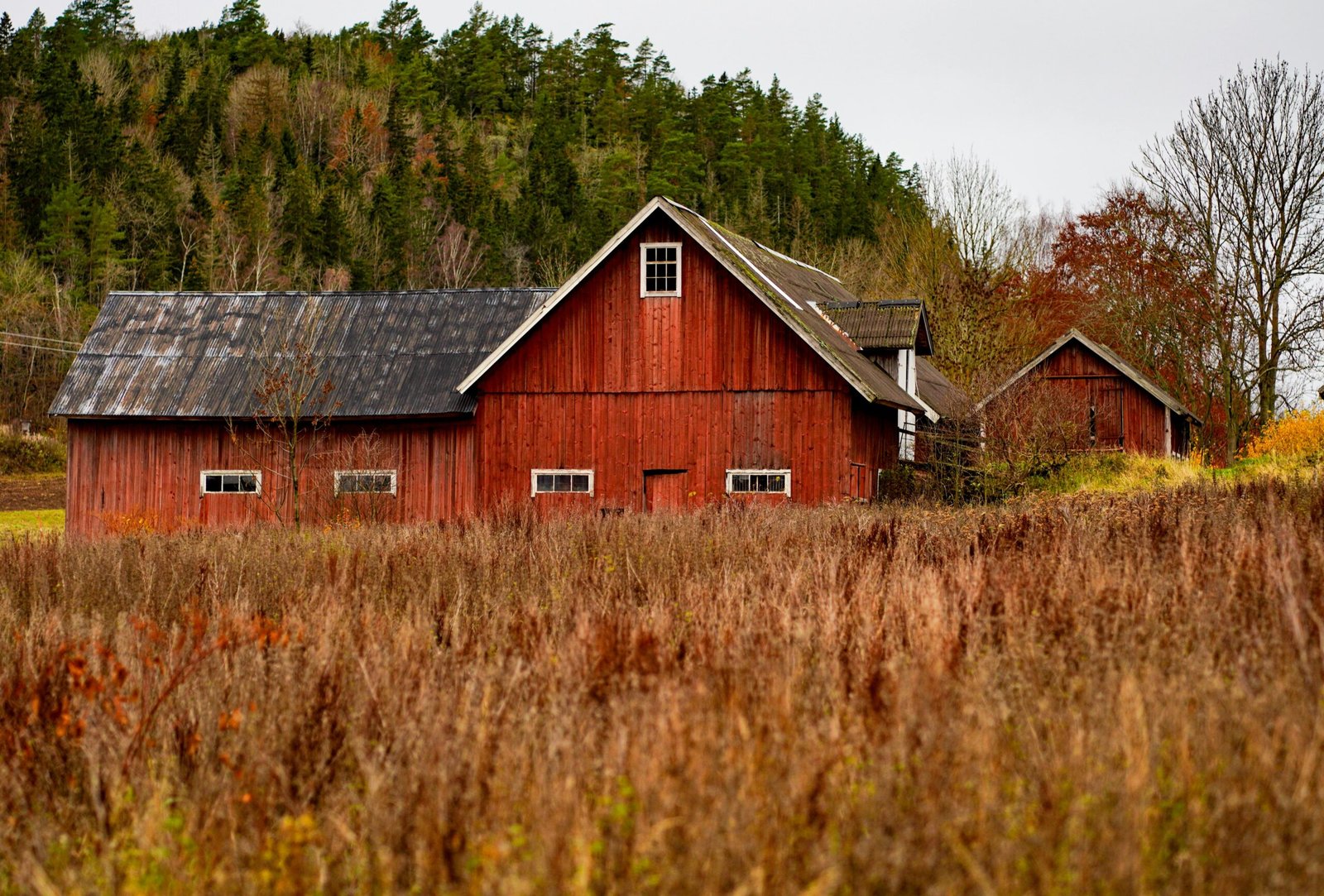
Alice Fenner's place was on the south side. I caught the weathered mailbox with Fenner hand-painted in cursive letters on the side before I caught the farm itself. A white two-story house set close to the gravel, a barn the color of old rust, and a scatter of outbuildings in various states of ambition. One of them, on the south side of the property where the road curved, was a chicken coop. I slowed and looked.
Nothing.
The building was a shabby red, boards warped and graying at the edges. The kind of building that had been functional for so long that nobody had bothered to think about how it looked. I could see the north side and part of the east. Nothing on either of them except old paint peeling away in strips.
I kept driving.
Past the Fenner place, the road dipped, curving right before straightening toward a newer-looking farm on my left, the Hines property, I assumed, based on the for-sale sign staked near the gate. I could see that beyond that, County Rd. G seemed to lose confidence, narrowing slightly before it met the intersection with Wooded Trail Road. I slowly pulled into the Hines driveway, backed out, and headed north again.
And that's when I saw it.
Or rather, that's when I saw where it had been.
The south side of the chicken coop came into view as the road curved, and it stopped me cold — not because of what was on it, but because of what wasn't. The rest of the coop was that same weathered red, boards silvered with age and weather. But the south-facing wall was white. Not old white, not faded white. Fresh white. The kind of white that still has a slight sheen to it, that catches the flat October light and gives it back a little brighter than it deserves.
Someone had recently painted that side of the coop.
I turned into the short gravel drive of the Fenner farm and had barely gotten the truck into park when a dog came around the corner of the house at a full run, barking with the kind of conviction that suggested he hadn't yet been informed that I wasn't a threat. He was a big animal. A German Shepherd somewhere in the mix, gray and tan, with the broad chest and alert ears of a dog that took his responsibilities seriously. He also had three legs, his right hind leg cleanly missing, which did nothing to slow him down or diminish his outrage.
I stayed in the truck.
The farmhouse door opened, and a woman appeared on the porch. She was somewhere in her sixties, with long gray hair loose around her shoulders. She had the kind of face that had spent a lot of time outdoors and had made peace with it. She wore jeans, cowboy boots, and a western shirt under a painter's smock that had seen considerable action. Streaks of color across the front told a long, creative history. Large earrings dangled from both ears, catching the light when she moved.
"Dennis," she said. Not loudly. Just firmly.
Dennis, apparently, knew that tone. He stopped barking, looked back at her with an expression of professional disappointment, and hobbled back toward the porch, where he settled in the shade. He had made his point.
The woman came down the porch steps and crossed the yard toward me. I got out of the truck.
She looked at me with mild curiosity. "Tony DeLucca?"
"In the flesh,” I said, surprised she recognized me.
"I know your mother. Knew her." Something shifted briefly in her expression. "I was sorry to hear about your Mom. She was a good woman."
"Thank you," I said. "She was."
"Clay's been in your shop." She tilted her head slightly. "Says you carry some good stuff."
I had seen her husband come in a few times. He played guitar in a bluegrass band when he wasn’t selling his jewelry at a cooperative artist space housed in a steel building just East of Alexandria. "He's got good taste."
She smiled at that, brief and genuine, and then looked at me with the patience of a woman who had things to get back to. "I don't imagine you drove out here to pet a three-legged dog."
"I was in the record store this morning," I said. "Marveen Huppert came in to pick up a special order."
Alice Fenner's jaw set, telling me Marveen Huppert was not her favorite subject at the moment. "I still don't know what got into all of them bunch of old biddies," she said. "I painted a goat. I've been painting animals my whole life." She said it, in the way you state something that should not require stating.
“Thanks to Kent Larson, it’s been painted over, so now they can go bother someone else.”
"The police chief called you?" I asked
"Yesterday." She glanced toward the freshly painted wall without warmth. "He was very polite about it. Asked nicely. But still." She shook her head. "I'd like to know what exactly those old women thought they saw to get their panties in a bunch."
I smiled at her, calling them old, since she was roughly the same age. "Do you still have the reference you worked from?"
She looked at me for a moment. "Wait here."
She went back inside. Dennis lifted his head from the porch, assessed me with dark intelligent eyes, and apparently decided that the investigation warranted a closer look. He crossed the yard with his efficient three-legged gait and began a thorough professional examination of my immediate vicinity, starting, with considerable enthusiasm, at approximately waist height.
I stood very still.
Alice came back out carrying a children's coloring book, the kind you find in the magazine section of a grocery store. Farm Animals of the Midwest. She said something to Dennis without breaking stride, and he hobbled back to the porch, apparently satisfied with his findings.
She handed me the book, opened to a page near the middle.
There was the goat. Black and white line drawing, clean and simple, mid-stride, one rear leg extended back for balance. Completely, utterly, unambiguously a goat doing exactly what goats do.
I looked at it. I turned the book slightly. Looked at it from another angle. Turned it back.
"You see?" Alice said.
I handed the book back. "It's a goat," I said.
"It's a goat," she agreed. And then, with the quiet dignity of an artist whose work had been misunderstood, she tucked the coloring book under her arm and looked towards the coop.
Sadly, I’d never be able to compare her painting with the one in the book. Whatever had been there was gone, painted over with two coats of exterior white and whatever remained of a very strange week. I had driven four miles out of town, been accosted by a three-legged dog, and was standing in a gravel farmyard in October for nothing.
"Thank you for your time, Alice," I said.
She nodded. "Say hello to your father if you talk to him."
I said I would, got back in my truck, and headed north on G toward 212, the farm shrinking in my rearview mirror until the road curved and it disappeared.
I still had no idea what all the fuss was about.
Chapter 3
I found a spot on Jefferson Street, half a block down from the Bear Claw, which counted as good parking for a Friday morning. The temperature had dropped since I left the shop earlier. It was the slow October retreat of the weather that reminded you summer has been gone longer than you've been willing to admit. I turned my collar up and covered the distance between the truck and the bakery at a pace that suggested I had somewhere to be, which I didn't, not really.
The Bear Claw Bakery was doing that comfortable mid-morning thing it did between the breakfast rush and lunch. A few tables occupied, nobody in a hurry, the smell of coffee and something with cinnamon in it hitting you before you were fully through the door. Stacy was behind the counter, wiping down the espresso machine with focused energy. She was the type of person who cleaned things the way other people solved problems.
"Mr. DeLucca." She didn't look up.
"Stacy."
Brenda’s business partner had called me that, since I had moved back to Flat Rock and Brenda and I had started dating. She delivered the greeting with just enough formality to be funny, coming from a woman barely five years my junior. I'd given up asking her to call me Tony somewhere around month two. It had only encouraged her.
She finished up the machine’s rub-down and then gave me her undivided attention. “Here or to-go?” she asked.
“Sadly, let’s make it for the road,” I said. “My morning just got more interesting.”
Brenda was at a table near the window, a half-eaten scone and a coffee in front of her, going through what looked like order forms of some sort. She wore the expression of someone losing a quiet argument with math. She looked up from her paperwork, and her face did that thing it did whenever she saw me. It was a look of warmth, amusement, and relief all at once, like the morning had just gotten marginally better. I walked over to the table.
"Where are you off to?" she asked.
“More like, where am I getting back from. I was just out to see Alice Fenner, not too far from your house.”
“Oh? And how was that?”
"Educational," I said.
She pushed her work aside, which told me the math could wait. "Sit down and tell me about it."
I took the chair across from her. Stacy arrived with the coffee and set it down without ceremony, and then lingered, because she always lingered when there was something worth hearing.
Stacy’s niece was at the corner table, laptop open, headphones around her neck, a half-drunk oat milk something at her elbow. She gave me a brief wave without fully surfacing from whatever she was working on.
Charlotte was a Political Science major at the University of Minnesota in St. Cloud, living with her aunt to save herself from the kind of student debt that follows you into middle age. The drive between Flat Rock and St. Cloud had apparently begun to wear on her, because Fridays had become her day off. The day was spent partly studying at the corner table and partly helping Stacy run the counter. By Saturday, she was fully on the clock, which suited everyone. She had a quiet competence about her that made the bakery run smoother without anyone quite being able to explain why.
I proceeded to tell them about the record store’s visitor that morning, and Marveen’s depiction of the artwork on the chicken coop. By the time I got to the part of Jeremiah embarrassing her with the politically correct term for a goat’s genitalia, I had Brenda's full attention and Stacy had stopped pretending to have anywhere else to be.
The short-haired barista let out a laugh loud enough for Charlotte to hear something from beyond her headphones, and look up.
Stacy composed herself, wiped her eye with the back of her hand, and looked at me with great seriousness. "This goat," she said. "Does it happen to have a human brother?"
Brenda almost spat out her coffee onto the paperwork.
I told them about visiting Alice and, of course, about Dennis making his professional assessment of me.
“So, you saw the original picture. Did it look like the painting that Alice did on the chicken coop?” Brenda asked.
“That’s the thing… I don’t know. The book she showed me was nothing but a goat doing exactly what goats do. I couldn’t compare it to anything, because she had already painted over the side of the building where it was.”
"So, nobody knows what it looked like except the people who saw it," Stacy said.
"Betty Lindahl saw it," I said. "She called Marveen. Then she called her son, the mayor, the mayor called Kent, and Kent called Alice."
"And now it's gone," Brenda said.
"Under two coats of exterior white."
"Dennis," Stacy repeated.
"As in the Menace."
She considered this. "That tracks."
"And Alice has no idea what the problem was?" Brenda asked.
"Alice has opinions about the people who had the problem," I said. "Whether she understands what the problem actually was is a separate question."
There was a brief silence while we all contemplated the thoroughness of that.
The bell above the door rang someone’s presence, and Stacy walked over to meet Bryce Hammond at the counter. He came in wearing a sports coat over an open-collar shirt and carried a leather portfolio that probably contained the professional files of several Flat Rock properties.
"Tony," he said, spotting me. "You escaped the little record store of yours."
"Just stopping in for some coffee," I said.
He ordered his latte from Stacy with the familiarity of a regular and leaned against the counter while he waited. "You should come see me one of these days," he said. "I've got a couple of listings that would be perfect for someone thinking about expanding their footprint.”
"I think the shop is a good size now, thank you."
“What about a house? You’ve gotta be tired of that tiny apartment, right? How about a house… maybe a little land to go with it?”
“I’ll keep it in mind,” I said, with no seriousness in my voice.
"Serious offer." He accepted his coffee and approached the group. "I have the perfect spot." He shook his head slightly. "Good bones. Needs work. But the land is solid."
He reached into his portfolio and dropped the listing sheet on the table in front of me with the confidence of a man who had never once doubted his own pitch. The Hines property. Four-bedroom farmhouse, outbuildings, twelve acres. The asking price was listed in bold at the bottom, a number that looked more comfortable on paper than in a checking account like mine.
"Keep it in mind," he said. "Something like that doesn't stay on the market long."
"I appreciate it, Bryce."
I folded the sheet in thirds and slid it into my jacket pocket with the polite intention of never looking at it again. It occurred to me that I had turned around in that very driveway not two hours ago.
Hammond seemed satisfied with that, said his goodbyes to the table, gave Stacy a wave, and headed back out into the Friday morning. The bell above the door chimed once behind him.
The three of us watched him go.
"Twelve acres," Stacy said, from behind the counter.
"Mm."
"On a record store salary."
"Thank you, Stacy."
Brenda smiled into her coffee. After a moment, she looked up at me. "So, what's next?"
I pushed back from the table and reached for my coffee. "I'm going to go see Chief Larson."
Chapter 4
I pulled into the municipal lot and cut the engine. The L-shaped complex that housed the fire station on Third and the police department facing Monroe was quiet, with most of the city employees escaping early on a Friday. I was halfway across the lot and heading for the entrance of the station when I spotted Kent Larson coming out the front door. He jaywalked his way diagonally across Monroe toward Mabel's, and I laughed at the irony. A classic case of do what I say, not what I do.
I changed direction and jogged to catch up.
"Kent."
He turned, saw me, and produced the expression of a man who had been hoping for an uncomplicated lunch.
"Tony." He waited while I covered the distance. "You look like a man with questions."
"Just one or two."
He studied me for a moment and then jerked his head toward the restaurant. "Come on then."
Mabel's sat on the corner of Third and Monroe, across the street from City Hall, and had looked more or less the same since I was old enough to ride my bike downtown. Fifteen red vinyl stools along the counter, five booths with cracked leather seats along the right wall, and a few scattered tables in the back where you could find a few of the older men in town playing cards early weekday mornings. They were long gone by now. The brown wood paneling on the walls was covered with black-and-white photos of Flat Rock's glory days. The floor was old linoleum, and I swore it was original to the building. The food was good, the coffee was strong, and the prices hadn't changed much since high school. In a town like Flat Rock, that counted for a lot.
Marge looked up from behind the counter when we came through the door. "Chief. Tony." She grabbed the coffee pot without being asked. "You boys want coffee?"
Kent slid into the second booth from the window across from Greg, who was already working on what looked like a patty melt. Two other deputies I recognized but couldn't reliably name filled out the rest of the booth.
I grabbed a lone chair from beside its spot next to the coatrack and pulled it up to the end of the booth like I'd been invited.
Greg looked up from his sandwich and then at me as if I was complicating his day. "He's not staying," he told Marge, who appeared at my side, with the quiet authority of a man who believed that saying a thing made it so.
Greg Ortworth and I had a history that was less a history and more a series of misunderstandings that had calcified over time into something neither of us had ever quite gotten around to addressing. He liked to think he was a good cop. There were others, including myself, who had a different opinion. It didn’t help that he had the people skills of a porcupine and a deep personal conviction that civilian involvement in anything remotely investigative was a sign of societal collapse.
Marge looked at me.
"Half a cup," I said.
Greg opened his mouth.
Kent looked at him, and the deputy went back to his patty melt.
Marge poured without comment and disappeared.
Kent wrapped both hands around his mug and looked at me with the patience of a man who had learned that the fastest way through a conversation with me was to let it happen. "What can I do for you, Tony?"
"Alice Fenner," I said.
Something moved across his face. Not quite a wince. "I had a feeling."
"Walk me through it."
He shrugged, the gesture of a man describing something that required very little description. "The mayor called. Said his mother had a concern about a property on County Road G. Asked me to look into it." He took a sip of his coffee. "I looked into it."
"You drove out there?"
He looked at me. "I made a phone call."
"So, you never saw the painting?"
"I didn’t need to see it. Alice was cooperative. She said she’d paint over it. End of story." He set his mug down. "Or it should have been."
"What exactly did the mayor tell you his mother saw?"
Kent considered this with the careful expression of a man choosing his words in a public restaurant with three deputies present. "He indicated that the artwork was of a nature that could be considered inappropriate for a public road."
"That's very diplomatic."
"I thought so."
Greg made a sound that might have been a laugh and converted it quickly into a cough when Kent glanced at him.
"And you didn't ask for specifics," I said.
"Tony." Kent leaned forward slightly. "A woman was upset. Her son called me. I made a phone call. Nobody filed a complaint, nobody got arrested, nobody got hurt. That's what we call a good outcome."
"Betty Lindahl," I said.
"Is the mayor's mother," Kent said. "And a fine woman who has every right to not have to look at whatever she saw every time she drives past that property."
"Even though you don't know what she saw."
"Especially because I don't know what she saw." He picked up his coffee again. "There are things a man in my position is better off not knowing, Tony. This is one of them."
From behind his patty melt, without looking up, Greg said, "Why do you even care?"
It was, I had to admit, a reasonable question.
"Professional curiosity," I said.
Greg looked up at that. "You don't have a profession. You have a record store."
"Greg." Kent said it the way you say a dog's name when it's about to do something inadvisable.
Greg went back to his sandwich.
I took one last sip of my coffee, set the cup and some money on the table for Marge, and pushed the chair back. Kent watched me, knowing that as far as I was concerned, this wasn’t over.
"Tony," he said, as I stood. "Whatever you're looking into here — and I know you're looking into something — just remember that nobody asked you to."
"Nobody ever does," I said.
He almost smiled at that.
Greg did not.
Chapter 5
The Uff Da Shop sat on Third Street between Monroe and Fillmore, about two blocks from the record store, in a narrow storefront that had housed everything from an auto parts shop to a used bookstore over the years. The hand-painted sign above the door featured Norwegian folk-art designs in faded blues and reds, and the windows were filled with a display that stopped tourists long enough to make them feel like they'd discovered something special. If you considered special to be wooden trolls, carved butter molds, and small hand-lettered signs that said things like "Uff Da" and "Ja, Sure, You Betcha" in fonts that suggested authenticity without technically guaranteeing it.
I stepped inside, and the shop was warm and smelled of something faintly floral. Two women I didn't recognize were working their way along the shelves with the focused energy of people who had driven up from the Cities for the weekend and intended to bring back proof of it. Leaf peepers. Flat Rock got them every fall, and this was the last wave of them before the snow flew. People, checking out the last of the autumn leaves, while closing up cabins and squeezing the final drops out of fall before retreating back to their real lives. The town's population had been quietly shrinking back toward its winter number all week.
Betty Lindahl was behind the counter, wrapping something in tissue paper for a third customer with the practiced efficiency of a woman who had been doing this for years. She was somewhere in her late sixties, compact and tidy, with her silver hair cut short. She wore a cardigan with small reindeer across the front, which I was beginning to think might just be her standard uniform.
She looked up when I came in, and her face did what faces do in small towns. Recognized, categorized, and assigned a relationship in about half a second.
"Tony." Warm. Genuine. "I haven't seen you in here in a while."
"Mrs. Lindahl." I smiled. "Place looks great."
She finished with her customer and sent her off toward the sweater display with a recommendation I didn't catch, and then turned back to me. “And what can I help you find this afternoon?”
"I was hoping to talk to you," I said. "About Alice Fenner."
The warmth didn't exactly leave her face. It just... reorganized itself into something more carefully managed. "Oh," she said. And then, after a brief pause, "I see."
One of the leaf peepers appeared at the counter, holding a small Ziploc bag containing a dozen Cheerios and a hand-lettered label. Norwegian Donut Seeds. Betty's expression instantly reset to full shopkeeper mode.
She turned away from me, happy for the interruption.
"Aren't those fun?" she said, beaming. "We sell hundreds of those."
I stepped aside and waited.
Betty rang up the Norwegian gag gift, a hand-knitted table runner, and a set of wooden coasters with Viking ships on them, all while maintaining the kind of cheerful running commentary that turned a transaction into an experience. The tourist left delighted. Just as I was about to approach the counter and continue my interrogation, the second customer drifted to the counter with an armful of items, and Betty was off again.
I browsed, thinking the only way I was going to get my questions answered was to become a paying customer and trap her behind the register. There was a shelf of ceramic figurines near the back, trolls and elves and round-faced Santas. Next to them, a display of salt and pepper shakers. Vikings, moose, and a pair of round little gnomes with red hats, holding what appeared to be a tiny fish between them.
I picked up the gnomes, and found the price listed on the sticker underneath. Thirty dollars seemed like a bit much, but it was a small price to pay in order to finally get some resolution.
When the second customer finally made her way out the door, I brought them to the counter. Betty looked at the gnomes. Looked at me.
"I'll take these," I said.
She began wrapping them in tissue paper. I leaned on the counter.
"Betty," I said quietly. "I've been trying to find out what Alice painted on that coop that was so offensive. Nobody seems to know except you."
She kept her eyes on the tissue paper. "It's been handled, Tony."
"I know. I'm just curious what all the fuss—"
"It was disgusting," she said. Flatly. Firmly. The tissue paper crinkled as she folded it. "I nearly—" She stopped. Composed herself. "It was disgusting," she said again, as if that were both the beginning and the end of the matter.
She slid the gnomes into a small paper bag, told me the total, and took my money with the expression of a woman who had said everything she intended to say on the subject.
"Betty—"
"You have a good afternoon, Tony." She smiled at me. It was a very complete smile. The kind that closed doors.
She disappeared through the curtain into the back room.
I stood at the counter holding my paper bag. I gave it two minutes, maybe three, standing there among the trolls and the lutefisk seasoning and the Norwegian Donut Seeds, half hoping the sleigh bells above the door would announce another customer and force her back out. They didn't.
***
Minutes later, I was pulling the truck into a spot in front of B-Sharp when I heard it. Ian Anderson's flute cutting through the October air with the confidence of a man who had never once doubted his instrument choice.
Not faintly. Not as a suggestion of music leaking through a closed door. I heard it the way you hear an alarm clock at 4 in the morning. Shrill and jarring. A woman walking her dog on the opposite sidewalk glanced at the shop front as she passed. By her face, I could tell that she wasn’t a fan of Jethro Tull, or at least not at that volume. Her dog didn't react, which said something about either the dog's temperament or its taste in music.
I went inside.
Jeremiah was behind the counter, head down, sorting through a stack of new arrivals with the focused intensity he reserved for either exceptional vinyl or exceptional volume. Possibly both.
I looked at the wall. The one the store shared with Delores Krensky's antique shop next door.
I walked over and put my ear against the brick.
Jeremiah watched me. "What are you doing?"
"Listening."
"For what?"
"Delores."
My neighbor had a not-so-subtle way of making it clear that the music in the record store was louder than she appreciated, usually by banging on the wall between our establishments.
He looked at the brick divider and then turned back at me. "I haven't heard anything."
It then occurred to him, visibly and with some delay, that the reason he hadn't heard her protests was currently coming out of the speakers at full volume.
"...Oh."
He reached over and turned the music down, without another word, and suddenly, quiet settled over the shop like the season’s first snow.
I went to hang my jacket on the hook behind the counter, and the listing sheet for the Hines property slid out and landed on the floor. Jeremiah picked it up, unfolding it and studied it with mild interest.
"You thinking about moving?"
"No."
His eyes dropped down to the asking price. "Good call."
He set it on the counter in front of me. "Any luck with the risqué goat painting?”
“Nope. Alice painted over it, as a favor to Chief Larson, and no one other than Betty and Alice saw it. So, it’s basically one woman’s word against another’s.”
“It’s too bad we can’t get an observation of this masterpiece from someone impartial.”
“I don’t think that exists here in Flat Rock,” I told him. “Everyone here has an opinion on something.”
“Not me.” He said, feigning innocence.
“Especially you.”
“I don’t have an opinion on anything. Every word that leaves my mouth is pure fact, my friend.”
I shook my head in disbelief that he would even say that and then picked up the listing sheet again. The property was nice. Severely out of my price range, but it could be a good fit for the right person. That person just wasn’t me. The photos were arranged across the bottom. Farmhouse. Barn. The long view south down County Road G.
And that’s when I saw it.
Chapter 6
I took out my phone and called the number listed at the bottom of the page.
He picked up on the second ring, because Hammond always picked up. "Hammond Real Estate, making dreams come true.”
I rolled my eyes at his greeting but continued.
“Bryce, it’s Tony--from B-Sharp.”
“Tony. Don't tell me you're calling about that farmhouse."
"I’m not," I said, but thinking fast on my feet, I responded, "A customer of mine is looking to get out of the Cities and wants some land. Can you send me those photos of the property?”
"Why don’t we set up a showing? When can he come look at it?”
"He's..." I paused for just a second. "A recluse. That's the thing. This could be perfect for him. I just need to get the man to commit. Send me every photo you have from the property. Everything you shot when you were out there."
“Shoot me your email, buddy-boy, and consider them already on their way," he said, with the enthusiasm of a man for whom sending photos required no deliberation whatsoever.
I gave him my email and thanked him before disconnecting the call. Jeremiah's brow furrowed in a way that suggested he had questions but wasn't sure where to start.
I didn’t have time to bring him fully up to speed. I put my phone in my pocket, retrieved my jacket from the hook, and headed for the door.
"Where are you going?" Jeremiah asked.
"Bear Claw."
He nodded, as if this were the only reasonable conclusion to a Friday afternoon in Flat Rock. Which, when I thought about it, it probably was.
“Try and keep the music at a respectable level while I’m gone, yes?”
“I’ll do what I can,” he answered, which was his way of saying that he made no promises.
***
I pushed past a large group of weekend warriors deciding between apple fritters and Brenda's signature bear claw. My girlfriend was still posted up at the table by the window, the order forms replaced by an elaborate latte and a paperback. She looked up when she saw me, read my face, and reached for her drink.
I had shoved the plastic bag from the Uff Da Shop in my pocket as I left the truck, and pulled it out, setting it on the table in front of her.
She looked at it. "What's this?"
"A gift."
She opened the bag and produced the two ceramic gnomes, holding one in each hand, examining them with the careful expression of a woman trying to decide how she felt about this.
"Gnomes," she said.
"Norwegian."
She set them on the table and looked at me. "Don't ask?"
"Probably best."
She smiled and pushed the chair across from her out with her foot. I sat down and took out my phone as it buzzed in my hand.
I thumbed over to my email, and true to his word, Hammond had sent over 68 photos from the listing on County Road G. I opened them one by one, enlarging each one as far as my phone screen would allow, squinting at the backgrounds, the edges, the corners. The Hines farmhouse from the south. The barn from the east. The long view back up the gravel road toward the highway.
And there, in the background of the third photo, barely visible where the road curved — the Fenner chicken coop. A small red shape against the tree line. I could make out the south-facing wall, lighter than the rest. But at this size, on a phone screen, it was nothing. A smudge. A suggestion.
I stared at it until my eyes watered.
Brenda watched me for a while. "What are you looking for?"
"The coop," I said. "It should be in the background of one of these."
She leaned over and looked at the screen. "That?" She pointed at the smudge on the twenty-third photo.
"That."
She studied it. "You can't see anything."
"I know."
We sat with that for a moment.
I picked up Brenda's coffee by mistake. She watched me take a sip without saying a word. It was like drinking a candy bar. I set it down carefully, the way you set down something that has just reminded you that you and your girlfriend have fundamentally different relationships with sugar.
She picked up one of the gnomes and looked at it for a long moment. Then she set it down next to its companion, straightening them both so they were facing the same direction.
"I like them," she said.
“For thirty dollars, I should hope so,” I said.
A real coffee appeared at my elbow. Charlotte set it down without ceremony and stood there looking at the phone in my hand with the mild curiosity of someone who had been watching me squint at a screen from across the room for the last ten minutes and had finally decided to investigate.
"What are you trying to see?" she asked.
I scrolled through the photos until I reached the one in question, pointed to the tiny building in the background, and handed her the phone. She looked at it, tilting it slightly, then handed it back.
"Email it to me," she said. "All of them."
She went back to her corner table, opened her laptop, and began logging in. Brenda and I watched her settle in with the quiet efficiency of someone who had already solved the problem in her head and was simply going through the motions of proving it.
I forwarded the photos to the email Charlotte gave me and walked over to where she sat, typing vigorously.
I drank my coffee -- my own this time -- and watched Charlotte's fingers move across the keyboard.
"You know," Brenda said, without looking up from her book, "most people would have just let this go."
"Most people didn't drive four miles out of town and get sniffed by a three legged dog."
Chapter 7
After a while of standing behind Charlotte, watching her work, she shooed me away from her shoulder with a backward wave that left no room for negotiation. I retreated to the window side table, slightly chastened, and we settled back into the comfortable rhythm of waiting. Brenda with her paperback, me with my coffee, Stacy moving between the counter and the tables, cleaning up before the bakery closed for the day.
The customers had thinned out, the apple fritter debate long since resolved, and the few remaining customers slowly packed up. Outside, the October light was doing that thing it does in Minnesota in the fall, going golden and slightly melancholy, like it knew what was coming and was making the most of the time it had left.
"Okay."
Charlotte said it quietly, without fanfare, the way you announce something when you already know the answer and have known it for the last ten minutes. Brenda and I got up and crossed the room together. Stacy appeared next to us, as if she'd been summoned.
The young woman turned the laptop around.
There it was. Hammond's photo, the long view north up County Road G from the Hines property. Charlotte had pulled up the background and sharpened it until Alice Fenner's chicken coop filled the screen, the red-boarded south wall facing the camera with complete and total clarity.
I studied it the way I studied things. Professionally. Methodically.
"It's not even that big of a deal," Brenda said, studying the screen. "All that fuss over something that small. What a disappointment."
"That's pretty common," Stacy said.
Brenda looked up. "I meant the leg."
"Oh, I know," Stacy said, smirking, and headed back to the counter.
Nobody said anything for a moment.
Brenda looked at me. I looked at Charlotte. Charlotte closed the laptop with the serene expression of someone whose work here was done.
"Thank you, Charlotte," I said.
I picked up my coat from where it hung on the back of the chair and slipped it on.
"What are you doing tonight?" I asked Brenda.
"Halloween cookie order. Twelve dozen. I have to be up at four."
"I'll call you tomorrow?"
“Deal,” she said, and kissed me on the cheek before I headed out the door and down the street to the truck.
***
Jeremiah had already locked up by the time I got back. The shop was dark, the CLOSED sign facing out. I was sure he had straightened the new arrivals bin and wiped down the counter, which was his way of leaving things better than he found them without making a production of it. After climbing the stairs to my apartment, I stood in the kitchen for a moment, finally deciding to skip dinner and just grab a Pig’s Eye Pilsner from the fridge instead. A pork chop in every can, as Dick Larson, owner of the Prohibition Bar and Grill, liked to say.
I had called Alice from the truck on the way back to the shop. She'd picked up on the third ring, Dennis audible in the background, doing what sounded like his professional assessment of something out in the yard.
I told her what the photo had showed, and what the angle from the road had done to the perspective of the hind leg — smaller, set back, positioned forward for movement — and how, at scale, on the side of a building, coming around a curve at thirty miles an hour, it had looked like something that had no business being on a chicken coop on a public road in northern Minnesota.
There was a long silence on the other end of the line.
"I used a children's coloring book," she said finally.
"I know."
"I've been painting animals my whole life."
"I know that too."
Another silence.
"You could try painting it again," I suggested slowly, "Now that you’re aware of what the problem was. Adjust the leg. Change the angle."
I could almost hear her contemplating the idea. And then she spoke.
"I think I’m going to stick to painting fences," Alice said. “At least in view of the road and my nosy neighbors.”
She said it the way she said most things. Simply. Finally. With the quiet authority of a woman who had made up her mind and saw no reason to revisit the matter.
I took my beer to the shelf of records in the cabinet next to the television.
My fingers walked along the spines. The familiar names, the familiar colors, the geography of a collection that knew me better than most people did. I pulled out The Band, considered it, and put it back. Thought about Johnny Cash, or maybe John Denver. Something rural, something fitting the occasion. A tribute to the day, to Dennis, Alice, and the goat painted on a chicken coop. And to Betty Lindahl, hiding in her stockroom with her Norwegian Donut Seeds.
I had almost decided on Bob Dylan but slid it back with the rest.
I'd had enough rural artistry for one Friday.
I decided on something else. Something that had nothing to do with goats or chicken coops or ceramic gnomes or the geometry of a hind leg on a county road in October. I put the Cars Candy-O on the turntable, dropped the needle, and settled into the chair by the window, letting the day begin to loosen its hold.
The record turned, and I watched the last of the light fade from the window and thought about nothing. Which, after a day like this one, was exactly enough.
If you enjoyed this story, there are more waiting in Flat Rock.